
Inside the $3,500 Mattress That Adjusts Itself All Night: A Bryte Balance Review
Part of our complete guide: Bedroom Safety for Aging in Place: The Complete Guide
My mother has never once, in the years I’ve been helping manage her sleep, told me a mattress felt “too soft” or “too firm.” What she tells me is that her hip aches by 3 a.m., that she wakes up and has to talk herself through rolling onto her other side, that some nights she just doesn’t bother and stays put, uncomfortable, until morning. That is the real complaint underneath almost every mattress conversation I have with clients who are designing for an aging parent, or for themselves ten years out. It isn’t about softness. It’s about what happens to a body that can’t easily move itself out of pain.
A healthy sleeper shifts position dozens of times a night without ever waking up enough to remember it. That’s the body’s own pressure-relief system: weight settles on a hip or shoulder, circulation gets restricted, and before it becomes a problem, the nervous system nudges you to roll over. Aging complicates that system in two ways. Arthritis and joint stiffness make repositioning genuinely effortful, so people move less and stay in one position longer. And thinner skin combined with reduced circulation means the tissue over bony prominences — hips, shoulders, heels — tolerates sustained pressure far worse than it used to. Clinical guidance for pressure ulcer prevention actually reflects this: at-risk adults are advised to change position at least every six hours, and high-risk adults at least every four, with pressure-redistributing support surfaces recommended specifically because manual repositioning alone isn’t always enough or is done as clinical support, not by will.
Why active firmness actually matters for an aging body
This is where the category of “smart mattress” splits into two very different products, and it matters that you understand the difference before you spend anywhere near $3,500.
Most adjustable mattresses let you set a firmness level once, from a remote or an app, and that’s it until you change it again. That solves for preference. It does nothing for the pressure that builds up over the course of a single night as a body stays in one spot. A truly active system is different: it senses where pressure is concentrating in real time and adjusts the surface under that specific spot, continuously, without anyone touching a button. For someone who struggles to reposition independently, or who simply sleeps through the discomfort instead of resolving it, that ongoing redistribution is doing the job the body used to do on its own.
It also solves a second, quieter problem: partners with different needs. I hear this constantly from clients caring for a spouse — one person needs a firmer, more supportive surface for back pain, the other needs give for a bad hip, and neither wants to sleep in separate rooms over it. A bed that can genuinely differ, side to side, in both baseline firmness and moment-to-moment pressure response, is solving a real logistical and relational problem, not a luxury one.
What the Bryte Balance actually does
The Bryte Balance is a full mattress replacement, not a topper or a cover you add to an existing bed. Inside, the core is built from up to 90 individually controlled air chambers, organized into 16 independent zones, sitting under polyfoam comfort layers and a stretch-knit cover. Embedded ballistocardiography sensors — the same non-wearable technology used in some clinical monitoring — read heartbeat, breathing, movement, and pressure distribution continuously through the night. An onboard AI interprets that data and tells the chambers where to soften or firm up, in seconds, without you waking to notice it happened. Bryte cites research suggesting a typical mattress needs on the order of over a thousand of these micro-adjustments per sleeper per night; whether or not you take that number literally, the underlying claim, that pressure redistribution is a continuous process rather than a one-time setting, is the correct way to think about why this technology exists.
Each side of the bed operates independently, with its own firmness range and its own sensor data, so two people can have entirely different experiences on the same mattress. The system takes roughly a week to calibrate to a given sleeper before it’s working at full personalization.
Pricing starts around $3,495 for the entry Balance configuration, with the Signature and PRO tiers running from roughly $3,839 up past $5,999 depending on size and features like the memory foam comfort layer or advanced cooling fabric. Bryte includes a 100-night in-home trial with full refund and free pickup if it isn’t right, professional delivery and setup, and a 10-year limited warranty — full coverage on foam and fabric, with the electronic components (the balancers, sensors, and cords) covered on a four-year pro-rated basis. Affirm financing and HSA/FSA eligibility through TrueMed are both available, which matters when you’re weighing this against other home modifications competing for the same budget.
How it lives in a real bedroom
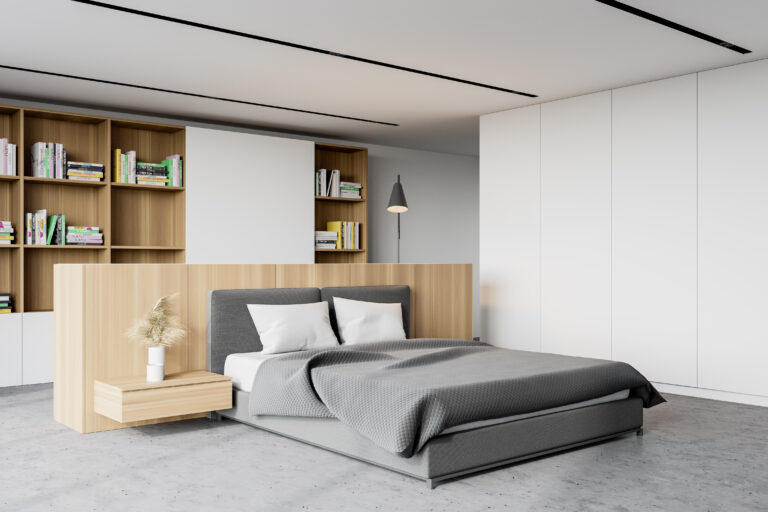
This is the part I care about most, professionally. Nothing about the Bryte Balance reads as adaptive equipment. There’s no visible bladder system, no hospital-grade upholstery, no obvious tell that this bed is doing anything different from a very good conventional mattress. The cover is a quiet, tailored stretch-knit in a neutral palette that takes to a proper linen program the way any well-made mattress should. The only infrastructure is a power connection and, on some configurations, a compact control hub that can be tucked out of sightline. If you’re designing a primary bedroom you actually want to spend time in — for yourself or for a parent who deserves a room that still looks like their own taste, not a care facility — this is a rare case where the highest-function option and the best-looking option are the same object.
Who this is actually for
I’d point a client toward the Bryte Balance when there’s a documented reason for continuous pressure management: limited mobility that makes independent repositioning difficult, existing joint or hip pain that worsens with sustained pressure, a caregiving household where a family member spends long hours in bed, or two partners with genuinely conflicting firmness needs. It is not a mattress I’d recommend simply because someone wants the most advanced option on the shelf. At this price, the value case rests entirely on whether active pressure relief is solving a problem you actually have.
Setup is professional and full-service, which I’d treat as a requirement rather than a convenience for this category of product; a bed with 90 internal chambers and embedded electronics isn’t something to improvise. Realistically, budget for the mattress itself plus a compatible adjustable base if you want the elevation and zero-gravity functions that pair well with active firmness for circulation and reflux management, which can bring the full setup closer to $6,000–$7,500. That is a significant number. I’d rather a client spend it deliberately, with a clear list of what symptom it’s addressing, than default into it because it’s the most technologically impressive line on a comparison chart.
Bryte Balance versus Eight Sleep: who should choose which
I feature both brands on this site because they are solving different problems, not competing versions of the same one, and conflating them leads people to buy the wrong thing.
Eight Sleep’s Pod is a smart cover that fits over your existing mattress, built primarily around water-based temperature regulation, along with sleep tracking and a smart alarm. It’s the right choice when the core complaint is temperature, night sweats, hot flashes, a couple who run at different temperatures, and when you don’t want to replace a mattress you already like. It’s also the lower financial and logistical commitment: no full mattress replacement, a shorter 30-night trial, and pricing generally under $3,000 before its ongoing software subscription.
The Bryte Balance is the right choice when the core complaint is physical: pressure, positional pain, joint discomfort, or the mechanics of staying comfortable through a full night without being able to reposition easily. It requires replacing the mattress entirely and asks for a higher upfront investment, but it is addressing the structural, orthopedic side of sleep that a cooling layer alone cannot touch. Some of Bryte’s higher configurations include a cool-to-touch cover, but temperature regulation isn’t the primary engineering focus the way it is for Eight Sleep.
If I had to put it plainly: Eight Sleep manages your climate. Bryte manages your body’s contact with the mattress itself. For a caregiving household where the presenting issue is a parent’s hip pain or a couple who can no longer share a firmness setting, that distinction is the whole decision.
My honest take
I don’t recommend the Bryte Balance to every client, and I wouldn’t recommend it to you without knowing what specific problem you’re solving. But for the households where pressure, positional pain, or a genuine mismatch between partners is the nightly obstacle, it’s the most capable piece of sleep furniture I’ve specified, and it does its work quietly enough that it never once reads as medical equipment. That combination, real function without the aesthetic compromise, is what earns a product a place on this list at all.



One Comment
Comments are closed.