The Aging-in-Place Case for a Smart Mattress: An Eight Sleep Pod Review
Part of our complete guide: Bedroom Safety for Aging in Place: The Complete Guide
When I walk a client’s home for an aging-in-place assessment, I check the obvious things first: threshold heights, grab bar blocking, whether the hallway lighting has enough lumens for eyes that need more of them at seventy than they did at forty. I rarely start with the mattress. Most designers don’t. But somewhere around the second year of managing my own parents’ care, I started paying closer attention to what actually happened in their bedroom at 2 a.m. — the kicked-off blankets, the up-and-down to adjust a thermostat down the hall, the mornings where “how did you sleep” got a shrug instead of an answer.
Temperature regulation and sleep quality are, I think, the most overlooked category in aging-in-place design. We spend enormous energy on the bathroom and the stairs — appropriately — and almost none on the eight hours a night that shape how someone functions the other sixteen. That imbalance is what sent me down the smart mattress rabbit hole, and specifically to the Eight Sleep Pod, which I’ve now spent real time researching and living with in my own house.
Why Sleep and Temperature Actually Matter More As We Age
This isn’t a comfort preference dressed up as a health claim. There’s a documented physiological shift here. A 2023 study published in Scientific Reports found that older women maintain a measurably higher core body temperature throughout the night than younger women — not because of impaired blood flow to the skin, but because of a decline in evaporative heat loss, the sweating-based cooling mechanism that normally helps the body shed heat during sleep. The researchers described it as a form of thermoregulatory dysfunction that tracks with the sleep-quality decline so many older adults report but can’t quite name.
The fragmentation side of the equation is arguably more consequential. A long-running cohort study following more than 700 community-dwelling older adults found that people with the most fragmented sleep — frequent, brief awakenings rather than long stretches of deep rest — had roughly one and a half times the risk of developing Alzheimer’s disease compared to those with the least fragmented sleep, even after controlling for total sleep time, activity level, and existing health conditions. Other research out of the same cohort has linked fragmented sleep to faster cognitive decline year over year. None of this means poor sleep causes dementia. It means sleep continuity is one of the few modifiable factors sitting in plain sight, and temperature discomfort is one of the most common, correctable reasons that continuity breaks down.
This is also where a tracking layer becomes genuinely useful rather than gimmicky. A caregiver — whether that’s an adult child checking in from another state or the person themselves — can’t easily notice a slow drift in resting heart rate or a pattern of restlessness that develops over weeks. A body doesn’t announce that kind of change. Data can flag it early enough to mention at the next doctor’s visit, which is a different proposition than a fitness gadget counting steps.
What the Eight Sleep Pod Actually Does
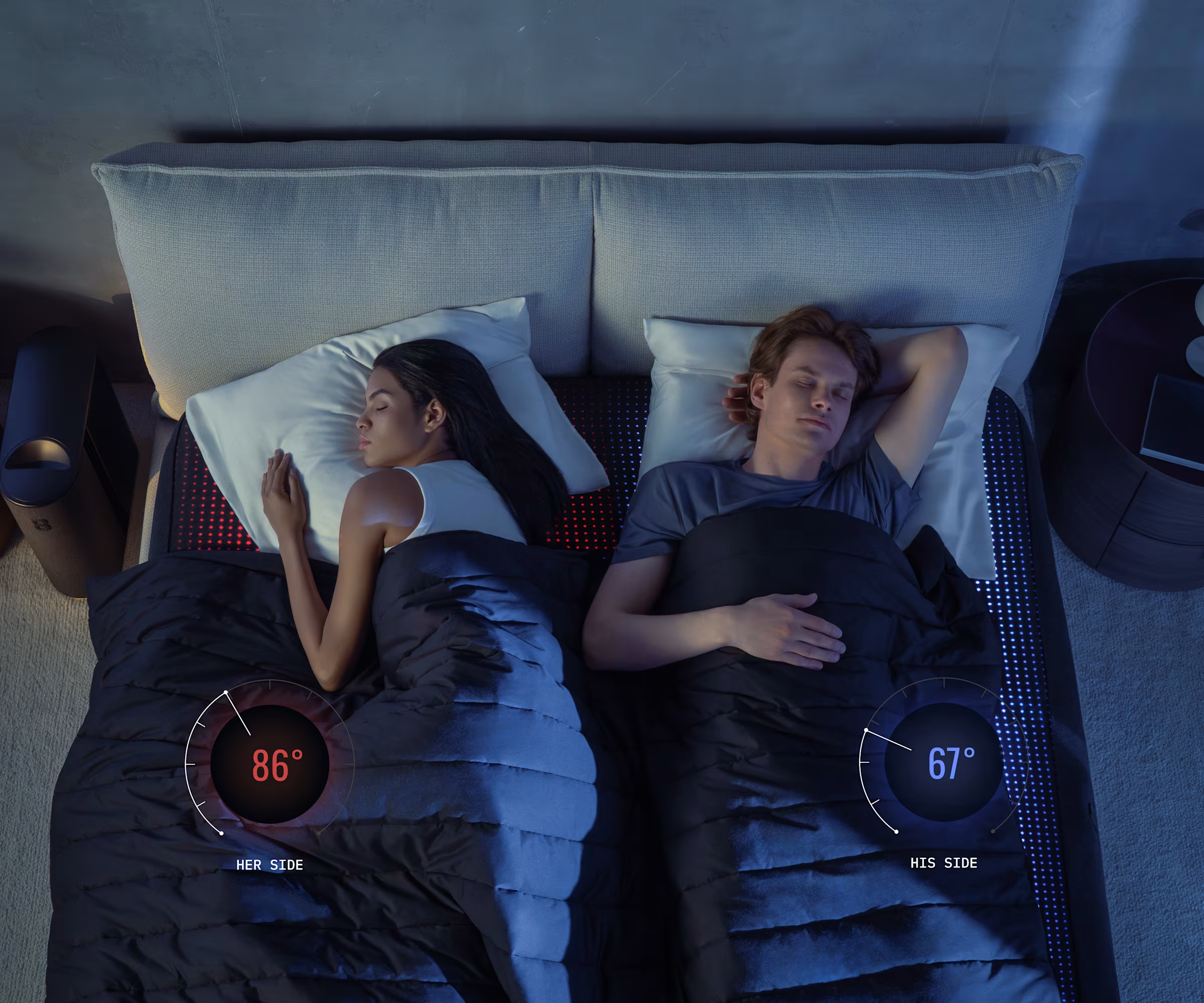
The Pod is not a new mattress. It’s a roughly one-inch-thick cover that sits on top of the mattress you already own, under your fitted sheet, connected to a bedside hub about the size of a small speaker. That distinction matters for a design brand: it means no bulky new bed frame, no visible technology in the room, nothing that reads as medical equipment. From across the room it looks like a very well-made bed.
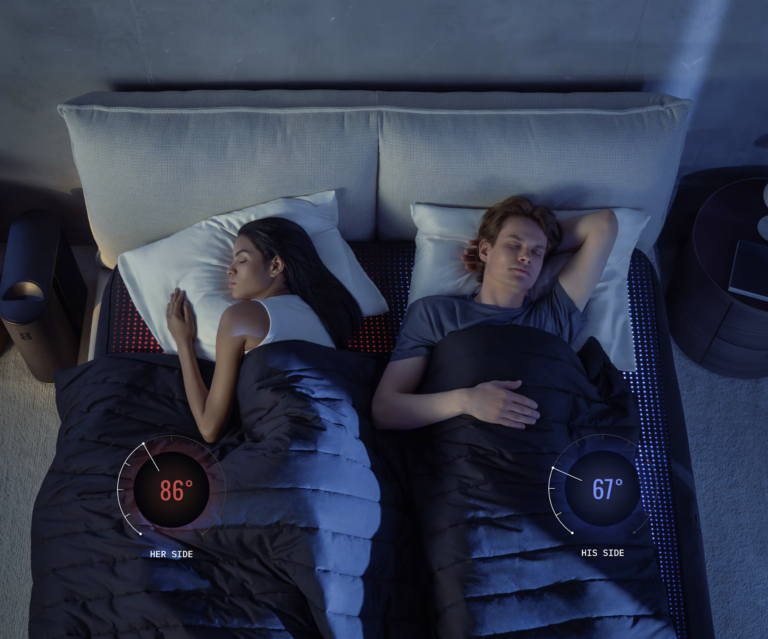
Underneath, it’s a water-based active grid that heats or cools each side of the bed independently, from 55°F to 110°F, in single-degree increments, reaching a set temperature in about five minutes. For couples with mismatched preferences — a common complaint I hear from clients managing a parent’s comfort against a spouse’s — this solves the argument entirely without either person compromising.
The app layer tracks heart rate, heart rate variability, respiratory rate, sleep stages, and snoring, and rolls it into a nightly Sleep Fitness score out of 100 measured against the person’s own baseline, not a generic average. Eight Sleep’s own research cites deep sleep improvements of up to 27 percent with regular use; I’d treat that as a company-reported figure worth verifying against your own results rather than a guarantee.
Pricing and What’s Included
- Cover pricing starts at $2,799 for a Full, $2,999 for a Queen, and $3,199 for a King or California King. Eight Sleep runs frequent promotions, so it’s worth checking current pricing — I’ve seen it discounted into the low $2,300s.
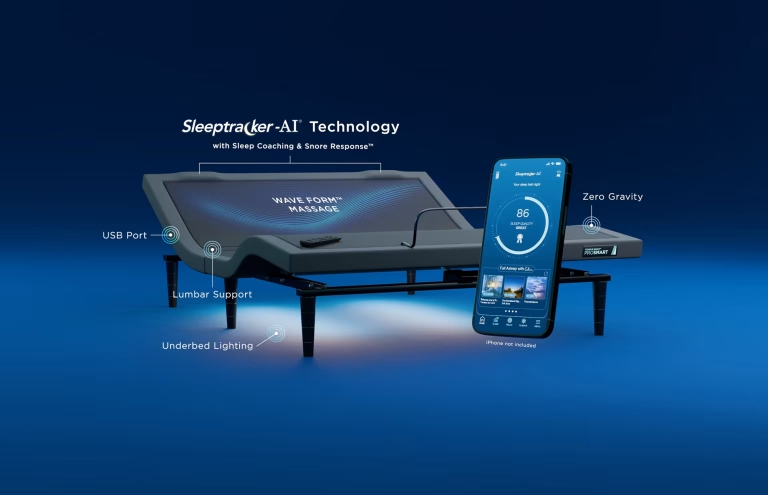
- Optional adjustable base runs an additional $1,999 if you want head and foot elevation as well.
- Financing through Affirm starts around $84 a month, and Eight Sleep also offers a rental option from $169 a month with no long-term commitment — a lower-risk way to test the concept before committing a parent’s household to it.
- The Autopilot subscription is required, not optional, and covers two sleepers per Pod: Standard at $17/month includes temperature automation and core tracking with a 2-year warranty; Enhanced at $25/month extends the warranty to 5 years; Elite at $33/month adds a Health Check feature with cardiovascular and respiratory monitoring.
- Trial and warranty: a 30-night risk-free trial with free return shipping and a full refund, plus the standard 2-year manufacturing warranty that extends to 5 years with an active Enhanced or Elite membership.
What a Caregiver Should Actually Know
I don’t sell anything on this site without thinking through how it performs in a household where the primary user might not be tech-fluent, and where a caregiver isn’t always in the room. A few honest notes:
- Setup is not a five-minute job. It requires wifi, an app account, and pairing the hub — plan on doing this yourself for a parent rather than expecting them to manage it, at least the first time.
- Once it’s running, daily use is passive. Autopilot adjusts temperature automatically through the night based on sleep stage, which is the right design for someone who won’t fuss with a phone app before bed.
- Remote visibility is the real caregiving value. If the account is shared, an adult child can check in on sleep patterns without a phone call that interrupts a parent’s day — useful for noticing a change worth mentioning to their physician.
- Route the hub cord along the wall, not across a walking path. The hub sits on the floor near the bed and needs occasional water refilling; in a fall-risk household, cord and hose placement deserves the same scrutiny as any other floor hazard.
- It is a wellness tool, not a medical device. The Health Check tier is useful context, not a diagnostic system, and it doesn’t replace a fall-detection pendant or clinical monitoring if that’s a real concern in the household.
- Budget for the subscription as an ongoing line item, not a one-time purchase — it’s easy to account for the mattress cost and forget the monthly fee that makes the core features work.
Two Honest Alternatives
The Pod isn’t the only option, and it isn’t the right fit for every household.
Sleep.me’s Chilipad/OOLER systems use similar water-based technology at a lower price point, from roughly $1,599 for a single-zone setup, with no required subscription — everything runs locally, including a physical bedside remote, which some of my less tech-comfortable clients genuinely prefer over an app. What you give up is the integrated tracking; you’d need a separate wearable if metrics matter to your household, and the interface, while simpler, feels a step behind Eight Sleep’s automation.
Sleep Number’s Climate360 is a fuller commitment: a complete smart bed replacement with per-side active cooling and warming, plus built-in SleepIQ tracking that needs no wearable at all. It’s a reasonable choice if you’re already replacing a mattress and want the technology built in from the start, but the investment climbs quickly — well into the $5,000 to $7,000 range with an adjustable base — and the bed itself is a larger, more visible piece of furniture than a retrofit cover, which matters if you’re trying to keep a bedroom looking like a bedroom rather than a hospital suite.
My Take
I don’t think every aging-in-place client needs a smart mattress the way they need a curbless shower or better lighting. But for a household that already has reliable wifi, a caregiver willing to help with initial setup, and a genuine pattern of temperature-driven sleep disruption, the Eight Sleep Pod is one of the few products in this category that does its job invisibly — no visible tubing, no bulky new bed, nothing that announces itself as a health device. It sits under the sheets and quietly does the work.
If you’re considering it for a parent, I’d start with the rental option or lean on the 30-night trial before committing to the purchase price. And I’d have the conversation about the subscription cost openly, the way you would with any recurring care expense — it’s a real number, and it’s worth deciding together whether the data it returns is worth it for your family.