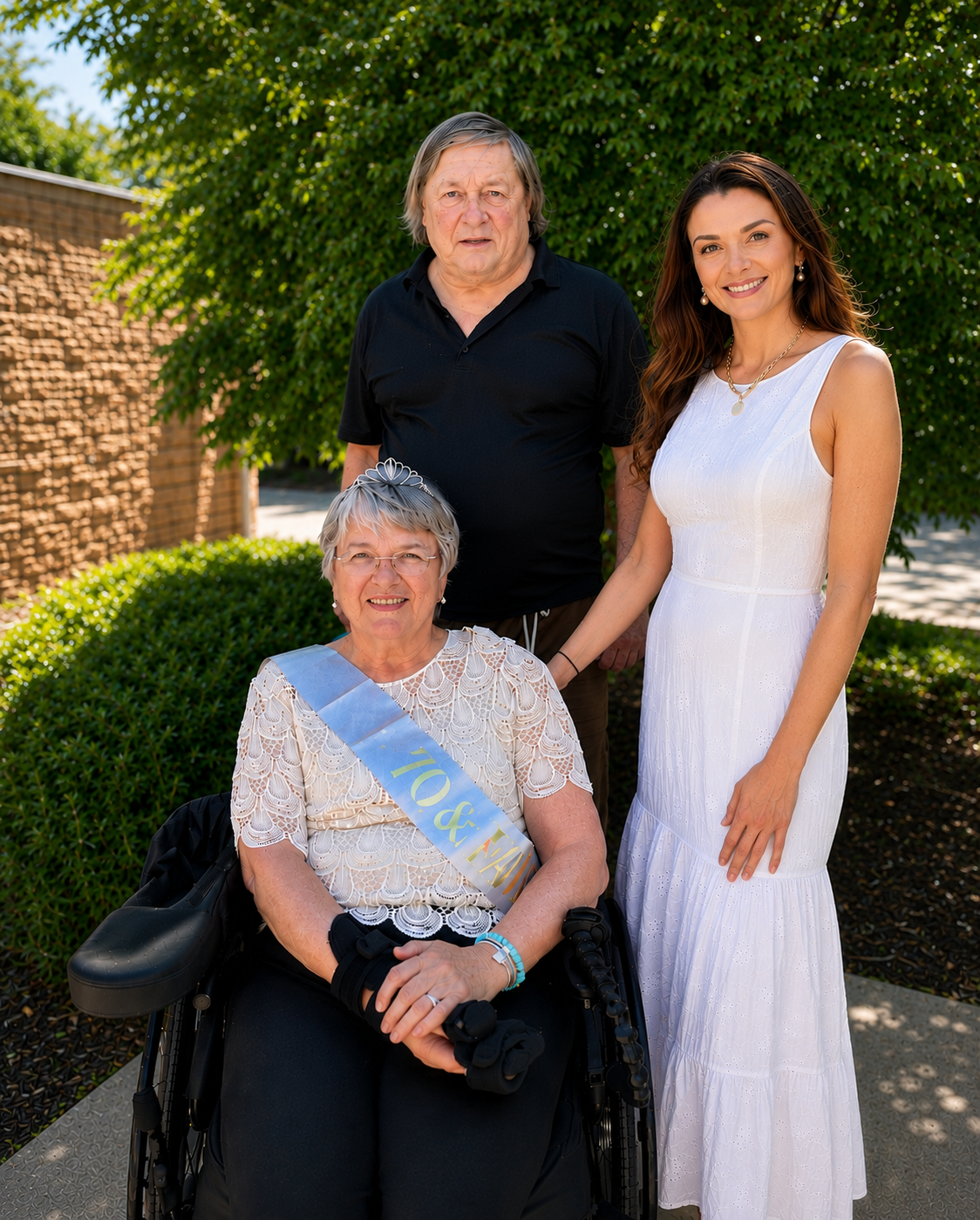
Rachel Blindauer
A designer. A daughter. Nine years in the trenches of family caregiving. This is the website built because no one else was telling the truth about any of it.
Nine years ago my mother had a stroke. Everyone was crying. I leaned down close to her ear and whispered, “Don’t worry. I’ll help you get back.” She calmed down. That night she was stable.
That moment was the beginning of a journey I never planned for, never trained for, and never could have imagined. Nine years later I’m still in it — and it has taught me how strong I can be, and about what matters.
The House That Started Everything
My parents built their home with their own hands, along with family friends who were architects, electricians, and plumbers. I grew up in that house. The smell of sawdust, family and friends, was my happy place. I visited design showcases and art museums as a kid and fell in love with how spaces make people feel. That house is why I became an interior designer.
It’s also a split-level with stairs in five different locations.
When my mom came home from rehab, we were expected to figure out how to make a home built for a young growing family work for someone who could no longer use 80% of the house. There is an occupational therapist that says you should make do with a twin bed in your dining room and a temporary toilet next to it, and they give you a discharge date. Having no privacy and waking up smelling feces is not an acceptable way to live — for anyone.
I even installed a used stair lift off Craigslist. She almost never used it. She just stopped going upstairs.
So my suggestion is spend a day watching what the person actually struggles with. The expensive obvious answer is rarely the one that moves the needle.
Putting Humpty Dumpty Back Together Again
I couldn’t sleep at night. I was up trying to figure out how to put my best friend and my mom back together again. I was reading neurology books, studies, neuroplasticity, longevity, till 3am. Recovery protocols. Peptides circa 2017. Emerging wellness research I’d never been anywhere near before. Light therapy helmets. NMN. Whatever the studies and the most recent science were pointing toward, I was looking for a solution.
I found trials she might qualify for. I learned how many therapy hours a week actually move the needle after a stroke, and then I learned what insurance covers, which is never nearly enough. So Mom and I did morning exercises together every morning, and I paid someone to walk with her at lunch. Eventually I knew more about her health and what would be good for her than the people treating her. Not because they were bad. They had four hundred patients and I had just one.
A lot of what I was finding was too far out for my mother, so I started trying things on myself first. If I was going to be her best advocate I needed to understand what I was recommending. So I took the vitamins. I ran the protocols. I became my own guinea pig, quietly and methodically, over years. Then a female researcher whose work I respect raised serious concerns about NAD+ boosters and cancer cell behavior, and I stopped the NMN. That’s how this works. You follow the science wherever it goes, including when it says wait — go back to the basics that are fully proven.
I only ever brought my mother what I truly knew and believed would work for her.
That was nine years ago. I haven’t stopped. Today my own health is run the same way: comprehensive bloodwork through Function Health, the results fed into the most advanced AI until they agree with my health goals, and daily protocols for everything from food to vitamins to hair, skin and makeup, printed and taped to the wall. After three to six months I retest. Feed the new information back in. Adjust again.
Supporting people through their home and through their body is the same way of thinking: assess what’s actually there, design for what’s needed, and build so the person will thrive not just today but ten years from now. Age 1 to 100. It teaches you what is important.
What Nobody Tells You About Caregiving
They don’t tell you that rehabilitation ends before the person, the family, and the house are ready.
They don’t tell you that your other parent may come apart at the same time, and that you will be managing two people while trying to hold your own life together.
They don’t tell you how to walk into a family home and find it buried — small trees grown up to your thighs in the yard, bags and clutter over every surface, a house that had become a picture of my dad’s grief and overwhelm.
And they don’t tell you what the third job does to you. I had a full-time job, designed furniture and lighting nights and weekends, and ran my parents’ entire administrative life. I didn’t have a life. I disappeared into execution.
There’s an insurance term for this. Key man: one person so critical to an operation that the whole thing collapses without them. Companies buy policies against it. Nobody insures a caregiver.
In one year I transformed that house. My father is calmer. Less angry. He came to my mother’s 70th birthday party. The environment and I did that.
Why I Built Well Aging Home
For a while, someone else paid for my mother’s therapy and hired a caregiver to be “me” for her while I was off working.
She had someone to do her therapy with. She had a friend. The woman drove her everywhere and gave her independence and a sense of control over her own life.
And every phone call stopped being “what do you need” and a list in response. I got to be a daughter again.
It cost $600 a month. It ended when we couldn’t keep paying for it.
That year rearranged what I think this work is for. All my mother wanted was control and autonomy over her life — and for me to not accidentally run her wheelchair into the doorway.
Which is why the two most useful things I’ve designed for my parents don’t appear on any home-safety checklist. For my father: a cheap computer and a high-yield savings account. Independence at his stage is financial, not physical. For my mother: a bathing system she can use herself.
I built Well Aging Home because I spent years looking for a resource that would tell me which of the things I tried actually moved the needle. What I found was either clinical and cold or generic and unhelpful. Nothing written by someone who knew what it felt like to be at the helm.
Everything here is researched carefully, and much of it is tested in my own family’s life. A designer’s eye for what is functional and beautiful, a caregiver’s read on what is helpful. No clinical clutter. No generic lists.
How I Find the Real Problem
There was a device my mother needed and wasn’t using, and she couldn’t tell me why due to her stroke. So I slept on her floor. All night, then all day, seeing where she struggled. Just watching. Then I fixed only the issues.
I still work this way. Every room I assess starts with a day of watching, and then four questions.
The Well Home Method
They are not a checklist. They are a way of seeing a home — the way a designer thinks, filtered through the experience of someone who has also been the one doing the lifting.
The threshold no one steps over cleanly anymore. The reach that strains. The lighting that makes a midnight trip down the hall dangerous. The thing the person living there has learned not to notice.
Not just safety from falls. The ability to make coffee alone, to wash without help, to answer the door without rushing. Independence is specific. It looks different in every home.
Grab bars that read as hardware. Smart switches that look like switches. Flooring chosen for beauty first, grip second. If the modification announces itself, it hasn’t been designed. It’s been installed.
The home should be designed for how the person lives now, and for how they might live later. The best modifications are the ones that never need to be redone.
Every product in Rachel’s Picks passes all four questions. Every article on this site is organized around them.
If You’re the One Holding It Together
I love you.
A lot of what I spent in the first year went to the wrong things. This site is the version of that year I wish someone had handed me.
— Rachel
Start where I wish I had.
Every Chapter — my room-by-room guide to a home that works from age one to one hundred, covering the entry, kitchen, bath, bedroom, living spaces, outdoors, and smart home. Nine design principles, and the products I’d specify for my own family. It’s the guide I’d hand myself in December 2016. Most of what’s in it costs less than the stair lift I didn’t need.
If you’re further along than that, Rachel’s Picks is everything I’d specify for my own parents, room by room.
A note on credentials: I’ve been an interior and furniture designer for more than 15 years — homes, boutique hotels, and over 1,000 designed products. My work and writing have been featured in House Beautiful, Martha Stewart, Livingetc, and California Home+Design. My design studio and interiors writing live at rachelblindauer.com; Well Aging Home is where that experience meets the caregiving years.
Some links on this site are affiliate links. If you purchase through them, I may earn a small commission at no extra cost to you. I only recommend things I’d stand behind for my own parents. Full disclosure here.