The Ideal Nightstand Setup for Safety + Ease
This post contains affiliate links. If you buy through them I may earn a small commission at no extra cost to you. How that works.
Part of our complete guide: Bedroom Safety for Aging in Place: The Complete Guide
Disclosure: Well Aging Home participates in affiliate programs. If you buy through our links, we may earn a small commission at no extra cost to you.
The nightstand is one of the most functional pieces of furniture in any home, and one of the most often neglected. What you keep on it — and how it is organized — affects how you wake up, how safely you move in the dark, and how much effort the first and last minutes of your day require. A thoughtful nightstand setup costs almost nothing to implement and pays dividends every single morning.
What Belongs on Every Nightstand
A Reliable Night Light
Motion-activated LED night lights that plug into the wall or sit on the nightstand surface are the simplest fall prevention tool available. The Govee LED Night Light and the Maxxima Motion-Sensing Plug-In both turn on automatically when you move and off when you are still. Place one on each side of the bed and one in the hallway leading to the bathroom. The goal is a lit path from bed to bathroom without turning on overhead lights that disrupt sleep. I’ve compared the options side by side in my guide to the best night lights for fall prevention.
Phone or Tablet on a Stand
A mounted phone stand eliminates fumbling in the dark and keeps the screen at a readable angle. It also means the phone is charging in a fixed, findable location rather than under pillows. The Lamicall adjustable phone stand is inexpensive and well-reviewed; a gooseneck version that clips to the nightstand is useful for anyone who reads in bed.
Water Within Reach
Hydration at night is straightforward but often overlooked. A lidded water bottle or a small carafe with a glass eliminates the need to get up for water and reduces the likelihood of a middle-of-the-night kitchen trip. A lid matters — reaching for water in the dark benefits from something spill-proof.
Medications and Daily Supplements
If morning or evening medications are part of the routine, a weekly pill organizer on the nightstand eliminates the morning trip to the kitchen or bathroom for this task. It also makes adherence easier: the pills are there, in front of you, with no barrier between intention and action.
What to Remove
Clutter on the nightstand directly corresponds to clutter during nighttime navigation. Stacks of books, charging cables trailing across the surface, loose items that shift and fall — these are friction sources that compound over thousands of nights. A simple rule: only things used daily belong on the nightstand surface. Everything else goes in the drawer or off the table entirely.
Nightstand Height
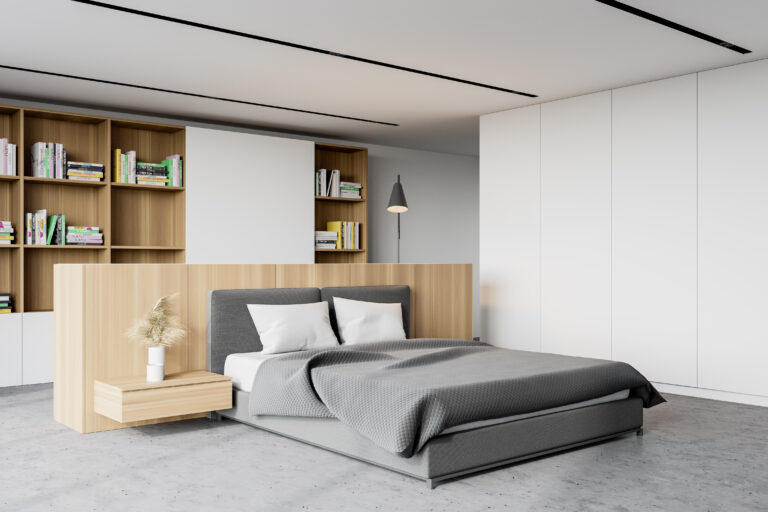
A nightstand that sits 2 to 4 inches above mattress height is the ergonomic ideal for most people. It allows items to be reached without sitting fully upright, and it positions a glass or medication at a level where spillage is less likely. If your current nightstand is significantly lower than the mattress, a small riser resolves this inexpensively. If getting in and out of bed is the harder part, pair the right-height nightstand with a minimal, secure bed rail — something steady to hold that doesn’t look clinical.
The Drawer
A reading light, a book, a charger, and emergency items — a flashlight, extra medication, a phone charger — belong in the drawer rather than on the surface. The surface should be clear enough to navigate by feel in the dark without knocking anything over. And if night sweats are what wake you, the fix starts with the bed itself: bedding that regulates temperature.