The Robot Mower That Took One Worry Off My Caregiving List
My father has mowed his own lawn for over forty years. It is not a chore to him. It is a Saturday morning ritual, a reason to be outside, proof that he is still the one who takes care of things. So when I started quietly steering him away from the riding mower two summers ago, it was not a conversation about lawn care. It was a conversation about identity, and those are always harder.
His yard has a slope along the back property line, nothing dramatic, the kind of grade you would not think twice about walking across. But a riding mower on that same incline shifts its center of gravity in a way that is easy to underestimate until you have watched someone catch themselves against the wheel. Add uneven ground near the drainage swale, a step down near the patio, and a body that does not recover its balance the way it used to, and you have a genuine hazard hiding inside an ordinary weekend task.
This is the tension I hear from clients constantly, and lived through myself as a caregiver for my own parents: the desire to keep doing things independently, against a risk that is real but rarely named out loud. Mowing is one of those risks. It gets filed under “yard work” instead of “fall prevention,” and I think that is a mistake.
An underdiscussed risk hiding in plain sight
We talk a great deal in aging-in-place design about bathroom grab bars and stair lighting, and rightly so. We talk much less about the backyard. But the numbers are not small. The CDC reports that more than one in four adults over 65 falls each year, and roughly 37 percent of those falls cause an injury serious enough to need medical care or to limit activity for at least a day. Falls are the leading cause of traumatic brain injury in older adults, and they send about three million people to the emergency department annually.
Layer mowing equipment onto that baseline risk and the picture gets more specific. Lawn mower injuries send tens of thousands of people to U.S. emergency rooms every year, and adults in their 60s and 70s account for a disproportionate share of the most serious outcomes, including a majority of deaths from lawn and garden equipment. Slope is a recurring factor in that data; uneven or graded terrain roughly doubles the likelihood of a mowing-related accident compared to flat ground. That tracks with what any physical therapist will tell you about aging: grip strength, core stability, and the quick weight-shift needed to correct a stumble are exactly the things that decline first, and they are exactly what a slope demands.
None of this means your parent should be talked out of the yard entirely. It means the equipment they are using deserves the same scrutiny we give a shower or a staircase.
Why wire-free, RTK-guided navigation changes the equation
The first generation of robot mowers solved a convenience problem, not a safety one. They relied on a thin boundary wire buried or pinned around the lawn’s edge, which meant hiring an installer, digging a trench along every slope and flower bed, and hoping the wire held up through a season of frost heave. For an irregular, sloped, aging-in-place yard, that installation is its own headache, and the mower still had to sense the wire’s signal to know where it was, which limited how precisely it could navigate near obstacles.
RTK GPS changes what the mower actually knows about the yard. Real-Time Kinematic positioning corrects standard GPS against a fixed reference point to get centimeter-level accuracy, rather than the several-meter margin of error you get from a phone’s GPS. Paired with onboard cameras and AI vision, the mower builds a precise map of your property by having you walk or drive the perimeter once through an app, no trenching required. That matters most on the exact terrain that worries me for aging parents: irregular lot lines, slopes, beds that curve around trees. A wire only tells a mower “you have crossed a line.” RTK and vision let it understand where it is, and adjust its approach to a slope or a tight corner in real time.
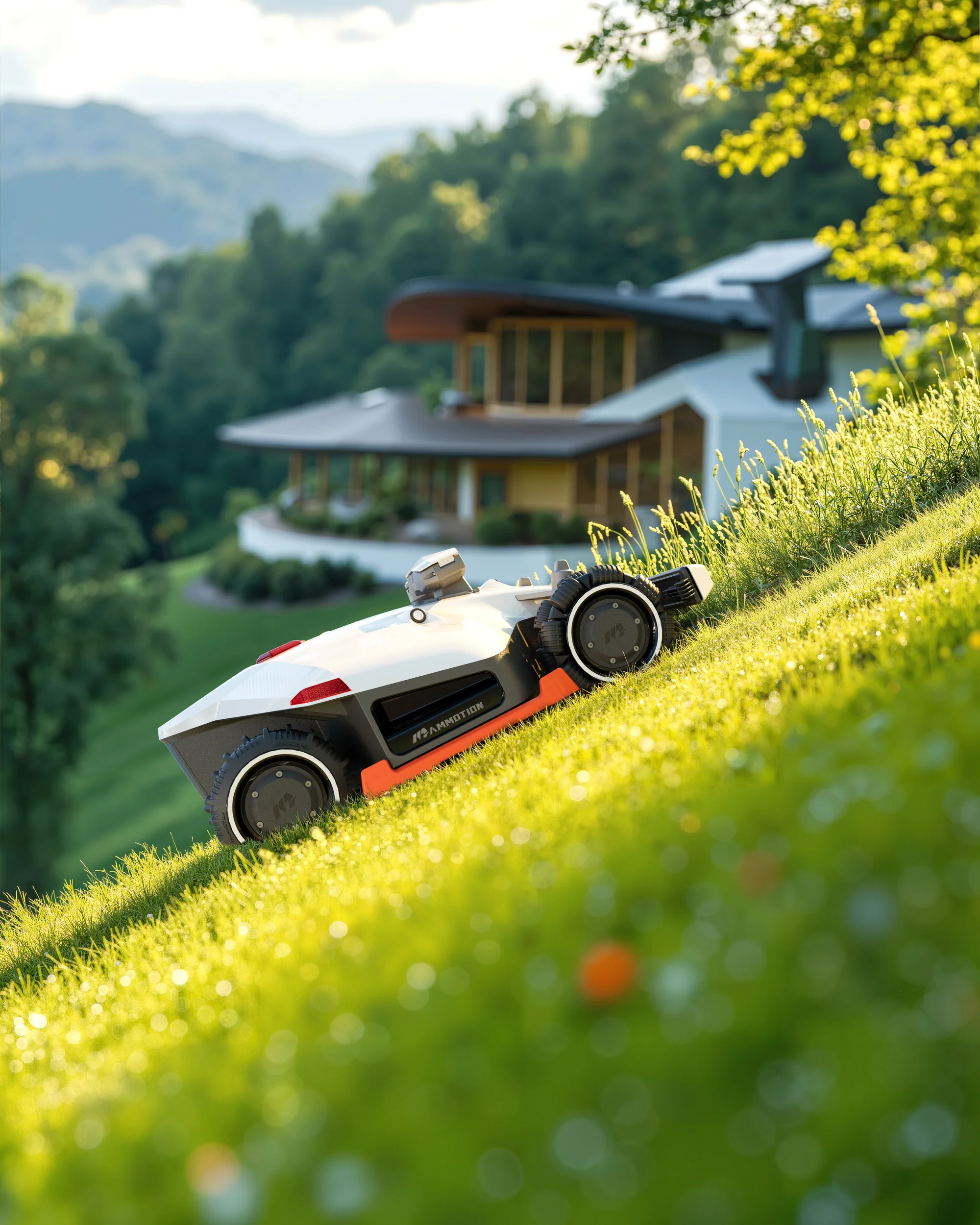
Rachel’s pick: Mammotion Luba 2 AWD 3000
This is the one I point clients toward when a parent’s yard has any grade to it at all. It is not the cheapest robot mower on the market, and it does not need to be. It earns its place on the spec sheet.
- Price: Currently listed around $2,299 to $2,599 depending on retailer and bundle (extra blades, an RTK antenna mount). Check current pricing before ordering, as these numbers shift with sales.
- Slope handling: All-wheel drive rated for grades up to 80 percent (about 38.6 degrees), which is the reason it belongs on this list. That is well beyond what most homeowners would attempt on foot with a push mower.
- Navigation: RTK GPS with a built-in reference station plus AI vision, no buried boundary wire. You set the perimeter once through the app.
- Obstacle handling: An onboard AI vision system distinguishes tall grass from real obstacles, including pets, toys, and people, and the mower can clear obstacles up to roughly 3.2 inches high without getting hung up.
- Coverage: Rated for about 0.75 acres on the 3000 model, with automatic recharge-and-resume so it picks up where it left off.
- App control: iOS and Android, with scheduling, real-time location tracking, adjustable cutting height, and notifications if the mower leaves its set zone.
What sold me was not any single feature but the combination: a mower that can handle real grade, understand its surroundings well enough to stop for a grandchild’s toy or a dog, and require no wire installation on ground that is already tricky to dig into. It is a serious piece of equipment styled like one, not a toy.
Setting it up for a parent, and for yourself
A few practical notes from actually living with this kind of equipment in a caregiving household.
The initial mapping walk takes some patience, and I would not hand a parent the app cold and expect them to complete it solo the first time. Do that first setup together, in person if you can, so they see exactly how the boundary is drawn and understand that the machine is not simply wandering. After that, day-to-day use is genuinely simple: it runs on a schedule, and most people rarely open the app at all.
The remote-monitoring piece is, honestly, the feature I care about most as the adult child managing this from a distance. Because the app runs over 4G or Wi-Fi rather than requiring you to be on the same home network, I can check that my father’s mower ran on schedule and see exactly where it is without a phone call. If it strays outside its mapped zone or gets stuck, the app flags it. That is a quiet layer of oversight that does not require asking him to report on himself, which matters for anyone protective of their independence.
On the safety side, the obstacle-avoidance sensors are worth testing yourself before you trust them fully with grandchildren or pets in the yard. I would treat AI vision as a strong second layer of protection, not a replacement for supervision when kids are playing nearby, the same way I would with any powered equipment. And do walk the actual mowing zones with your parent before finalizing them, particularly around drop-offs, retaining walls, or pool edges, since the mower will do exactly what the map tells it to do.
A low-pressure recommendation
Here is the value I did not expect when I started down this path: it was never really about the yard. It is about the fact that mowing dropped off my mental list entirely. I do not think about whether the ground was too wet to skip a week, whether the slope near the drainage swale got mowed safely, or whether I need to call and check in on a Saturday. As the person managing my parents’ care alongside my own work, that is the actual return on this purchase: one less recurring worry I carry, not simply one less chore for my father.
I do not think every parent needs to give up their yard, and I would never frame it that way to mine. What I do think is that the version of “keeping the yard” that involves a 200-pound riding mower on a slope, at 75 or 80, is worth quietly replacing with a version that keeps the routine and the pride intact, minus the specific hazard. My father still walks the yard every week to see how it looks. He just is not the one balancing on the incline to make it happen. If your parent’s lawn has any grade to it and mowing is a fight you would rather not keep having, this is where I would start.