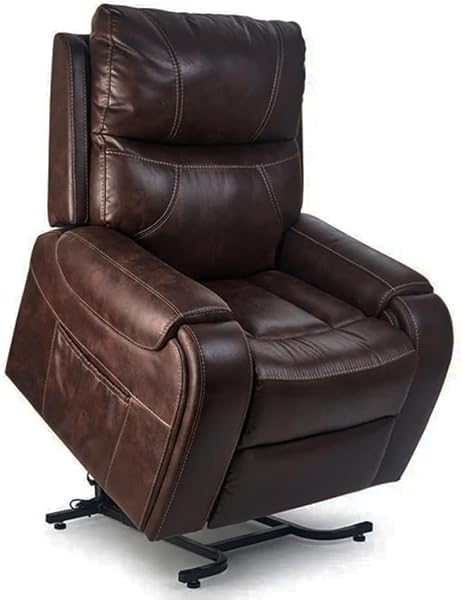
Best Lift Chair Recliners for Elderly Parents: A Designer and Caregiver’s Buying Guide (2026)
This post contains affiliate links. If you buy through them I may earn a small commission at no extra cost to you. How that works.
Part of our complete guide: Aging in Place: The Complete Guide. I’m a residential interior designer and a full-time caregiver for my parents. Over 15+ years designing homes, I’ve learned that most safety problems are solved by better design long before medical equipment enters the room. Well Aging Home participates in affiliate programs; if you buy through a link, I may earn a small commission at no extra cost to you.
Best lift chair recliner for elderly parents: quick answer
The Golden Technologies Titan — a multi-motor lift recliner with lithium battery backup, a lifetime frame warranty, and the silhouette of a proper reading chair — is the one I specified for my own family and keep specifying for clients, at roughly $1,800–$2,400. Pride Mobility’s Infinity or VivaLift lines if your parent is petite or tall and fit matters more; La-Z-Boy’s Pinnacle Platinum if you want hundreds of fabrics; Ashley’s Yandel under $1,000. Whichever you choose: measure the recline clearance, test the remote, and don’t buy the biggest chair “to be safe.”
Who should buy a lift chair
- Anyone who needs a second try — or a hand — to stand from a normal chair or sofa.
- Someone recovering from a hip or knee replacement, or sleeping upright after a procedure.
- Arthritis in the hips or knees, Parkinson’s, or general lower-body weakness.
- Anyone with edema or a cardiac condition whose doctor wants the legs elevated or the body reclined for long stretches.
- A caregiver who’s currently doing the lifting — the chair does the transfer so their back doesn’t.
If the person can rise easily from a firm 19-inch seat with arms, they don’t need a lift chair yet; they need a better chair. That’s a cheaper, better-looking fix, and I’d start there.
My father’s biggest fear isn’t struggling to stand up from a chair, it’s falling — especially on the stairs — and not being able to get himself back up. That fear shapes nearly every safety decision in his house. A lift recliner doesn’t solve for a fall on the stairs directly, but it does remove one small, repeated risk from his day: the moment of pushing up out of a low, soft chair with nothing to help him do it. That’s the moment I started paying attention to, and why I began actually researching lift recliners instead of assuming they all looked like hospital equipment and moving on.
They don’t, as it turns out. But finding the ones that don’t took some digging, and most of what I found written about lift chairs treats them as a medical purchase rather than a piece of furniture someone has to look at, live with, and want in their home. This guide is the one I wish I’d had: what actually matters when you’re choosing a lift chair for a parent, the one I ended up specifying for my own family’s living room, and the handful of others that look like furniture.
What I tell clients before buying a lift chair
Standing up is the hardest transfer of the day, and a normal recliner makes it harder. Rising from a seat asks for a coordinated push from legs, core and arms while balance is at its most vulnerable — you’re moving your center of gravity forward and up, off a base that’s about to get narrower. The CDC reports that more than one in four adults over 65 falls each year, and roughly a third of those falls cause an injury serious enough to need medical care or limit activity. A standard recliner works against a person exactly then: the seat is too low and too soft to push off from, the cushions absorb effort instead of returning it. A lift chair tilts the whole seat forward and up, bringing the person’s center of gravity over their feet before they have to generate that push. It’s closer to removing the single hardest transfer of the day than it is to a mobility aid.
Buy it as furniture. The chair that gets replaced in six months is the one nobody wanted to sit in. Choose a fabric that belongs in the room, put it where the primary seating goes — facing the TV, beside the side table, in the usual spot — and add a throw and a lamp. A well-placed lift chair in a good fabric disappears into a well-furnished room. Parked in a corner as “the medical chair,” it never will, and real estate agents will tell you a visibly medical living room costs you the young couple who’d otherwise buy the house. Think Four Seasons, not hospital.
Fit matters more than capacity. An oversized chair with feet that don’t reach the floor or a back that doesn’t meet the lumbar support is less stable during the lift cycle, not more. Size the chair to the person.
Think Four Seasons, not hospital
There isn’t a lift chair in the lobby of a Four Seasons — but every chair there is designed to be stood up from. That’s the picture: what a good hotel’s furniture does without anyone noticing.
- Seat height 18–20 inches, firm edge, arms you can push on. Hotel lounge chairs are specified so a guest of any age rises without a second try. At home, that’s the baseline; the lift mechanism is the extra layer.
- It reads as a chair. Tailored upholstery, a seamed back, proportions that match the sofa. Nothing announces its function.
- Everything within reach of the arm. A drinks table at elbow height, a lamp with a switch on the cord or a bedside-style remote, a charger built in.
- Placed in the best spot in the room — by the window, facing the view — not against the wall by the door.
What to actually look for
- Lift mechanism. A sturdy, slow, controlled lift — not a sudden tilt. Multi-motor systems (rather than a single motor driving both recline and lift) let the seat, back and footrest move somewhat independently: a smoother, more supported rise and more resting positions.
- Positions. Two-position chairs recline to near-flat and return upright; three-position recline further; infinite-position chairs adjust back and footrest independently, which lets the occupant find a zero-gravity position that spreads pressure — worth the extra cost for anyone spending real time in the chair, and for sleeping upright after a procedure.
- Weight capacity. Confirm it against your parent’s actual weight with margin; most quality chairs are rated 375–400 lb, bariatric models higher. Not a spec to round up on.
- Seat dimensions. Seat depth appropriate to leg length, width comfortable without excess. Too large and the person sinks in and the lift doesn’t help.
- Materials. Skin thins with age, so fabric that resists tearing, wipes clean and doesn’t trap heat matters clinically. Faux leather and performance textiles both work; avoid anything that pills, stains permanently, or feels clammy over an eight-hour day.
- Battery backup. The feature people forget until they need it. A chair on wall power alone strands someone mid-recline in an outage. A lithium backup returns the chair to an upright, exit-ready position with no power — essential if your parent lives alone.
- Remote. Large, clearly labeled buttons that work for arthritic hands. A confusing remote gets set aside, and a chair whose lift isn’t used isn’t doing its job.
- Warranty. Frame and lift mechanism should be long — lifetime, ideally — since that’s the structural part doing the work. Electrical and labor coverage are shorter; read them.
- Clearance. Lift chairs need 18–26 inches behind them to recline fully. Measure the room before you measure the chair.
My pick: the Golden Technologies Titan
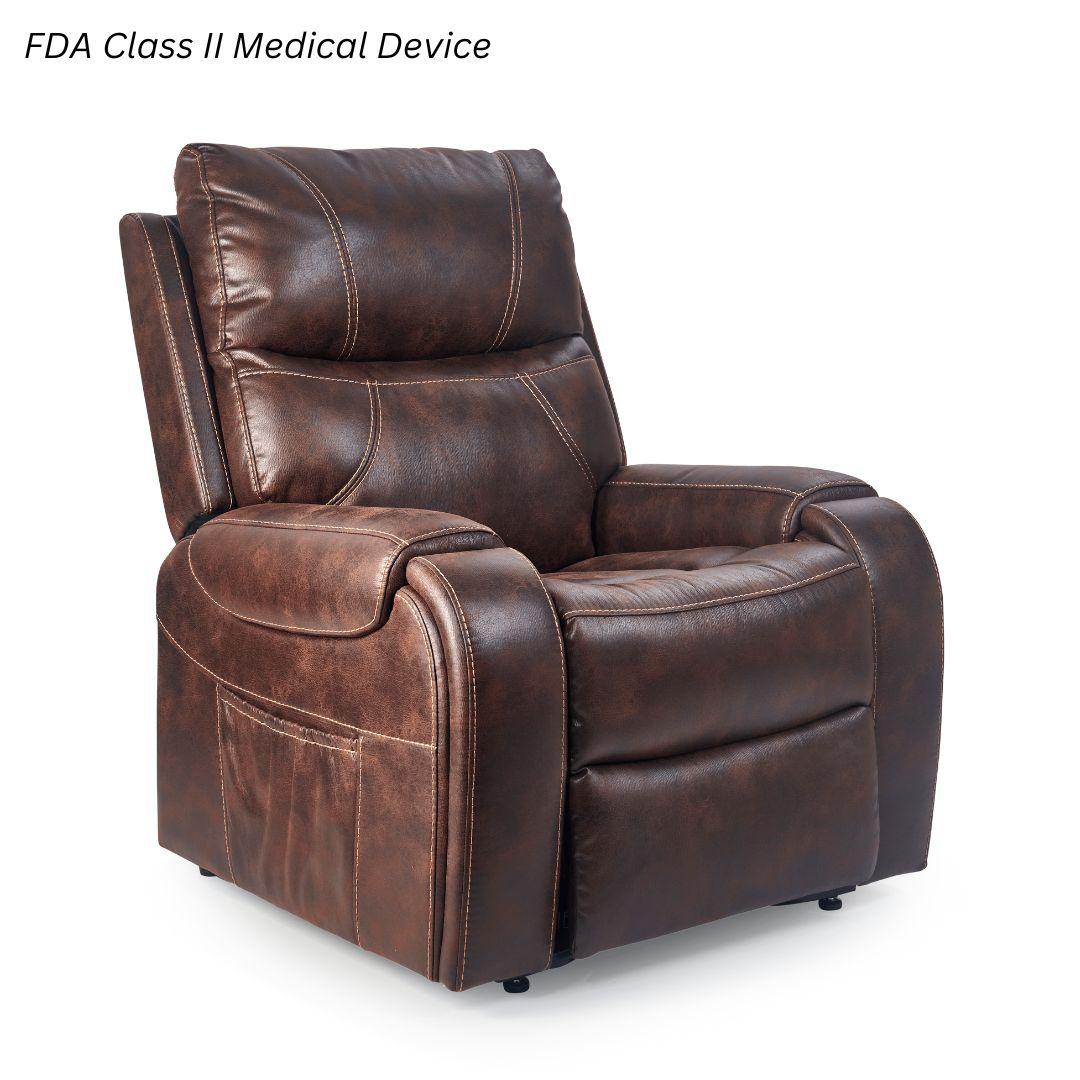
Golden Technologies Titan Lift Recliner
Medium-sized, stylish overstuffed seamed back, plush chaise pad. The least institutional lift chair on the market.
Rachel’s pick — the one in her family’s living room
This is the chair I ultimately specified, and the one I keep coming back to for clients furnishing a parent’s home. Golden Technologies has been building lift chairs for decades — this isn’t a furniture brand that added a motor, it’s a mobility company that understood upholstery mattered.
The Titan reads as a chair first. It has an overstuffed, seamed back and a plush chaise pad that gives it the silhouette of a proper reading chair rather than a recovery-room recliner — it doesn’t look out of place next to a good sofa, which is precisely the point. It comes in a medium sizing that suits most average-height adults without swallowing a smaller frame the way some oversized lift chairs do.
- Price: typically $1,800–$2,400 depending on retailer and fabric, landing around $2,200 for the medium in faux leather
- Weight capacity: up to 375–400 lb, depending on retailer spec sheet
- Lift system: multi-motor cradle with Golden’s 4-Zone positioning and programmable AutoDrive hand control — back, headrest, lumbar and footrest adjust independently
- Upholstery: faux leather in a small, tasteful range — graphite, maple, acorn — that reads as furniture-grade, not clinical vinyl
- Battery backup: lithium-ion, standard
- Extras that get used: cup holder, USB port, wireless phone charger, and a quick-release removable back for getting it through doorways
- Warranty: lifetime on frame and lift mechanism; three years electrical parts and mechanical labor; one year electrical labor; pro-rated through year seven
- Clearance: about 26 inches from the wall to reach full recline
What earns it a place on my list isn’t any single spec — it’s that nothing about it announces itself as medical equipment. The seaming, the chaise pad, the restrained palette: those are design decisions, not afterthoughts, and they’re the reason a parent will want to sit in it instead of resenting it.
Other lift chairs that look like furniture
The Titan isn’t the only well-made chair, and I’d rather tell you when something else makes more sense.
| Best for | Chair | Why | Price |
|---|---|---|---|
| Best overall | Golden Technologies Titan | Multi-motor, battery backup, lifetime frame warranty, reads as a reading chair | $1,800–$2,400 |
| Petite or tall parent | Pride Mobility Infinity (LC-525) | Small, medium and large frames; similar capacity and lift quality; 7-year pro-rated warranty | Similar to Titan |
| Design-first fabrics | Pride Mobility VivaLift Metro / Tranquil | Designed around aesthetics — linen, slate, cocoa; clean lines; a scale that suits most living rooms | $1,500–$2,500 |
| Hundreds of fabric choices | La-Z-Boy Pinnacle Platinum | Performance textiles, proportionate dimensions, custom program — a chair you could furnish around without apology | Meets or exceeds Titan |
| Budget, or continuity with an existing La-Z-Boy | La-Z-Boy entry lift models | Start under $1,500; single motor, fewer positioning zones — the cradle-like lift isn’t matched until the Platinum tier | Under $1,500 |
| Leather | Catnapper Cloud | Genuine leather and sophisticated fabrics; proportions close to standard furniture; strong build | $1,200–$2,000 |
| Best value | Signature Design by Ashley Yandel | Clean lines, solid mechanism, microfiber in brown or cream; widely available | Under $1,000 |
None of these are in my collection yet, so no cards — the Titan card above is the one I stand behind. I’d choose the Pride Infinity over the Titan specifically for a parent who’s petite or notably tall, where fit outweighs everything else.
Does Medicare cover a lift chair?
Partly — and the partly matters. Medicare Part B treats the seat-lift mechanism as durable medical equipment; it does not cover the chair, the upholstery, or any recline or massage features. So the reimbursement is for the motor, and it’s a modest amount — typically a few hundred dollars toward a chair that costs $1,000–$2,500 — with you paying 20% coinsurance on the approved amount plus everything else.
To qualify, your parent’s physician has to document that they:
- have severe arthritis of the hip or knee, or a severe neuromuscular disease;
- can’t stand up from a regular chair on their own;
- can walk — with or without a cane or walker — once standing (Medicare won’t cover a lift chair for someone who then needs a wheelchair);
- and that the chair is part of treating the condition, not a convenience.
The process: the doctor completes a Certificate of Medical Necessity for seat-lift mechanisms; you buy from a Medicare-enrolled supplier (many furniture stores aren’t); and the supplier bills Medicare for the mechanism. Medicare Advantage plans follow the same rule but vary in paperwork and suppliers — call the plan first. Medicaid varies by state. The VA covers lift chairs for eligible veterans through its own process.
My honest advice: don’t let the Medicare piece drive the chair choice. The mechanism reimbursement is small, the paperwork is real, and the wrong chair for the sake of a supplier’s inventory is a poor trade. Get the chair that fits; treat any reimbursement as a bonus. Full guide: does Medicare cover home modifications.
Safety considerations worth being explicit about
- Measure the room before you measure the chair. Pushed too close to the wall, the chair never reaches its safest reclined position.
- Check the remote for large, labeled buttons an arthritic hand can use.
- Don’t buy the biggest chair “to be safe.” Feet off the floor and a back that misses the lumbar make the lift cycle less stable.
- Ask about the battery backup specifically, and test it. Power outages are exactly when someone most needs to get up.
- If there’s a condition — significant edema, a recent hip or knee replacement, a cardiac issue that needs sleeping elevated — loop in the physical therapist or physician first. They may have a recline angle or seat height in mind.
How I make a lift chair disappear
A lift chair reads as medical when it’s treated as one — bought in isolation, parked where there’s room, left alone. Treated as the anchor of a seating vignette, it reads as the best chair in the house. What I do on every project:
- Match the upholstery to the room, not the catalog. Pick the chair fabric the way you’d pick a sofa: a tone from the rug or the drapery, a texture that talks to the other seating. If the manufacturer’s fabric range is thin, that’s the reason to consider La-Z-Boy’s custom program.
- Give it the best spot. By the window, facing the view or the fireplace, where the primary chair would go — not against the wall by the door.
- Build the vignette. A proper side table at elbow height on the favored side; a reading lamp with a switch on the cord or a remote; a throw in a good wool; a small tray for glasses and the remote. Now it’s a reading corner that happens to lift.
- Hide the cord and the remote. Route the cord along the wall to a floor outlet; a remote holder on the inside of the arm. Nothing on the floor.
- Keep the path. A clear 36 inches from the chair to the door; the rug either large enough that the chair sits fully on it, or none at all.
- Pair it with the sofa’s scale. A lift chair that’s noticeably bigger than everything else is what reads as equipment; a medium-size chair beside a full-size sofa reads as furniture.
Finishing the corner
The chair is the anchor; these are the pieces from my full collection that make the corner work.

Stander Adjustable TV Trays
For couches and recliners. Stable, height-adjustable surface for eating or working from any seated position.
A table that swings over the chair — no leaning, no reaching
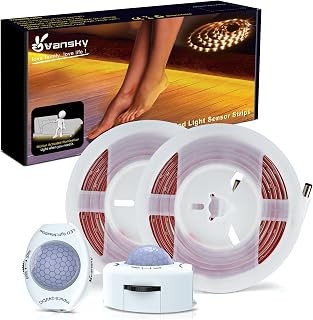
Vansky Motion-Activated Under-Bed Night Light
Soft floor path light for safe nighttime bathroom trips. No installation needed.
Also works under the chair for the evening nap
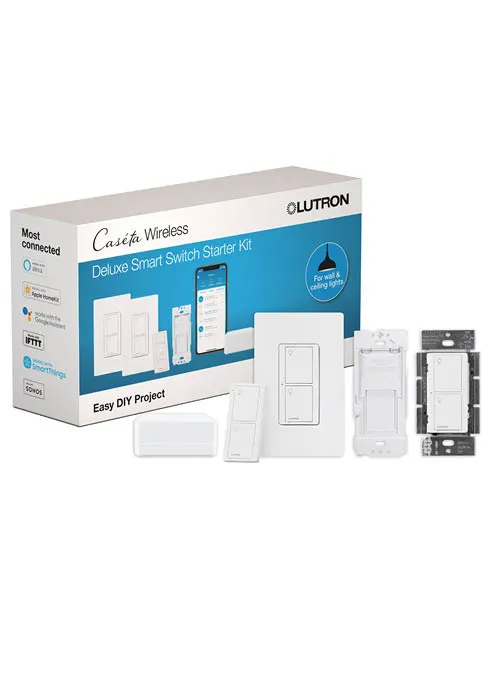
Lutron Caseta Wireless
The most reliable smart lighting foundation. Integrates with every major ecosystem. Rachel installs this first.
Lamp and overhead from the chair arm
Design notes: a side table at elbow height on the side the person favors; a lamp with a switch on the cord or a remote; a throw that isn’t a trip hazard; and a clear 36-inch path from the chair to the door. See walker-friendly living room ideas.
Who this is not for
- Anyone who can’t bear weight or control the descent once lifted — a lift chair raises you; it doesn’t hold you. That’s a PT conversation.
- Anyone with significant cognitive impairment who may not use the remote safely — consider a simpler two-button remote or a caregiver-operated model.
- A room without the recline clearance — measure first.
Frequently asked questions
Does Medicare cover a lift chair? Only the seat-lift mechanism, as durable medical equipment, when a physician documents severe arthritis or a neuromuscular disease and the person can walk once standing; expect a few hundred dollars toward the chair. See the full section above.
Two-position, three-position, or infinite? Infinite-position if the person spends real time in the chair or sleeps in it; two-position is fine for a chair used for TV and standing up.
How much room does a lift chair need? 18–26 inches behind it to recline fully; the Titan needs about 26.
What happens in a power outage? With a battery backup, the chair returns to upright so the person can get out. Without one, it stays where it is — which is why I won’t specify a chair without it.
How much does a good lift chair cost? $1,000–$2,500 for a well-made chair with a multi-motor lift and battery backup; under $1,000 buys a solid single-motor value chair.
For fall-risk assessment, the CDC’s STEADI program. Related: best adjustable beds for seniors, canes that actually look stylish, universal design ideas that add home value.
The design comes first
If I’m furnishing one chair for a parent’s living room and it needs to do real work — assist a real transfer, survive a power outage, hold up daily for years — the Titan is where I start. It’s priced like a serious piece of furniture because it’s built like one, and it doesn’t ask your parent to trade dignity for safety. The only wrong choice, in my experience, is the chair that gets replaced in six months because no one wanted to actually sit in it.
Free resource: 12 Changes That Make a Home Safer Without Looking Clinical.
Similar Posts
Walker-Friendly Living Room Ideas: How to Create a Safer, More Beautiful Space
A walker-friendly living room doesn’t mean a medical room. Interior designer Rachel Blindauer shares the exact measurements, furniture specs, flooring choices, and layout strategies that make a living room work beautifully for walker users — without sacrificing style.
The Best Canes That Actually Look Stylish (2026): A Designer’s Guide — and the House That Works With One
The hospital-issue aluminum tube still works — it just isn’t the only option anymore. Canes with real stability and furniture-quality design, for anyone who’d rather not carry obvious medical equipment.
The Best Wheelchairs for Home Use (2026): A Designer’s Guide — and the House That Makes One Work
Wheelchair selection is more individualized than almost any other mobility product — it depends on how much the user can self-propel, how much time they spend in the chair, and what a caregiver can manage for lifting and transport. Here’s how to navigate the categories, and the one brand standard I specify across all of them.