Is an Infrared Sauna Safe for Seniors? What to Know Before You Buy
The question comes up more than any other when I’m designing a wellness space for an aging parent’s home: can I put in a sauna? Usually it starts with good intentions. A daughter wants to give her mother something that feels like a spa, not a hospital. A son wants his father to have a reason to look forward to Tuesday afternoons. I understand the impulse completely, because I live it too. My parents are in their eighties, I manage their care alongside my design work, and I have learned that almost every “nice to have” amenity in a home for an aging body needs to be run through a safety filter first, luxury second.
So before I talk about the unit I actually recommend, I want to answer the real question, the one under the question. Not “which sauna looks best in a primary suite,” but whether heat therapy is something an older body should be doing at all, and under what conditions.
The Safety Considerations to Understand First
Infrared saunas have a reasonable body of research behind them, and much of it is genuinely encouraging. But encouraging is not the same as unconditional, and the nuance matters more as we age.
Cardiovascular strain
Heat exposure causes vasodilation, the widening of blood vessels, which is part of why sauna use is associated with lower blood pressure over time in population studies. A single session can also produce a real, immediate drop in blood pressure, along with a temporary rise in heart rate as the heart works to move blood toward the skin’s surface to release heat. For a healthy older adult, that’s typically a tolerable, even beneficial, cardiovascular workout. For someone with unstable angina, a recent heart attack or stroke, severe aortic valve stenosis, or decompensated heart failure, it can be a meaningful stressor on a heart that doesn’t have the reserve to handle it. This is not a category where “probably fine” is good enough.
Blood pressure medications
This is the interaction I flag first with every family I work with. Many antihypertensive medications already lower blood pressure and relax blood vessels. Add the vasodilation of heat exposure on top of that, and the combination can push blood pressure down further and faster than either alone, sometimes enough to cause dizziness, lightheadedness, or fainting on standing. It doesn’t mean sauna use is off the table if a parent takes blood pressure medication. It means the timing, dosage, and session length need to be discussed with the prescribing physician, not decided by trial and error in a warm room.
Dehydration
Sweating in a heated cabin causes real fluid and electrolyte loss, and older adults are already more prone to dehydration for reasons that have nothing to do with saunas: reduced thirst sensation, medications like diuretics, and kidneys that are less efficient at conserving water. Watch for the early signals, thirst, dry mouth, headache, muscle cramping, and confusion, and treat any of them as a reason to stop, not push through.
Heat intolerance
The body’s ability to regulate its own temperature, through sweating and adjusting blood flow, becomes less efficient with age. That’s simply a physiological reality, not a judgment. It means an older adult can move from comfortably warm to overheated more quickly than a younger person would in the same room, often without the same early warning signs. This is one of the reasons heat-related illness disproportionately affects adults over 65, and it’s a central reason session length and supervision matter more here than they would for a thirty-year-old.
When to avoid sauna use entirely
Skip it, full stop, with a recent heart attack or stroke, unstable angina, decompensated heart failure, severe aortic stenosis, uncontrolled high or low blood pressure, active infection or fever, or when alcohol or sedating medication is involved. This list isn’t exhaustive, and it isn’t a substitute for a conversation with a doctor who knows the individual’s full health picture.
Why “ask your doctor first” is the real answer
I say this as someone who sells home wellness pieces for a living: no product page can account for someone’s specific cardiac history, current medications, or kidney function. A physician can. Before any sauna purchase for an older parent, get their doctor’s input on whether heat therapy is appropriate at all, and if so, what session length and frequency make sense for that person. That conversation should happen before the sauna arrives, not after.
Why Low-EMF and Far-Infrared Specifically Matter
Once a doctor has cleared sauna use, the type of sauna becomes the design question, and it’s worth understanding two things: infrared versus steam, and EMF level.
Traditional steam and rock saunas run hot, often 150°F to 195°F, heating the air around the body. Far-infrared saunas use infrared panels to warm the body more directly at a lower ambient air temperature, typically in the 110°F to 140°F range. That lower operating temperature tends to be more tolerable for an older body while still producing a sweat and the vasodilation effect described above. It’s a gentler on-ramp, which is exactly what I want in a home built around someone with less cardiovascular reserve.
EMF, or electromagnetic field exposure, is the second consideration, and it’s specific to the heating technology itself. Standard infrared heating elements, particularly older or budget models, can emit meaningfully higher electromagnetic fields at close range, since a person sitting in a sauna is inches from the heating panels for an extended period. There’s no universally agreed-upon danger threshold for this kind of low-level, non-ionizing exposure, but the precautionary logic is straightforward: if a shielded, ultra-low-EMF design exists at a comparable price and performance point, and someone is going to be sitting a few inches from a heat source multiple times a week for years, choose the lower-exposure option. It costs nothing in comfort or effectiveness.
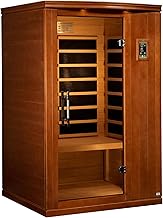
Rachel’s Pick: The Dynamic San Marino Elite 2-Person Sauna
This is the one I point families toward when a doctor has given the go-ahead and we’re ready to talk product. It’s sold through Costco, which for a purchase like this is actually a point in its favor: straightforward return policy, member support, and pricing that moves with Costco’s periodic promotions, generally landing in the low-to-mid two-thousand-dollar range rather than the four-thousand-plus you’ll see on comparable units elsewhere.
- Heating: Six Carbon PureTech ultra-low-EMF far-infrared panels positioned at the rear wall, both side walls, under the bench, and in the floor, so heat reaches the body from multiple directions rather than one hot spot.
- EMF rating: Manufacturer-rated ultra-low EMF, in the single-digit milligauss range at close range to the panels, well below what you’ll find in many standard infrared units.
- Temperature range: Up to 140°F, with an optimal operating range around 118°F to 132°F, gentler than a traditional steam sauna’s ceiling.
- Materials: Natural Canadian hemlock wood construction, a stable, low-off-gassing softwood commonly used in sauna building for its durability and light, warm tone.
- Red light therapy: Built-in chromotherapy lighting plus a dedicated red light feature, positioned as a complementary wellness layer rather than the headline function.
- Footprint: Exterior roughly 47″W x 42″D x 75″H, interior about 43″W x 37″D x 68″H, sized for two, and modest enough to fit a primary suite, bonus room, or converted closet without a renovation.
- Power: Runs on a standard 120V/15-amp household outlet, no dedicated 220V line required, which matters when you’re retrofitting an existing home rather than building new.
- Assembly: Panel-based construction, roughly a one-hour job for two people, no specialty tools needed.
- Warranty: Five years on heating elements and electronics, one year on the wood structure and radio component.
- Price: Typically found in the $2,000 to $2,500 range at Costco.com, with pricing subject to their rotating member promotions.
What earns it a place on my list isn’t the red light feature or the finish, though both are genuinely well done. It’s the combination of a shielded, low-EMF heating system, a moderate temperature ceiling that suits an older body better than a scorching traditional sauna, and a footprint and power requirement that make it realistic to install in an existing home without an electrician rewiring the circuit panel.
Setting It Up Safely
The sauna itself is only half the safety picture. How it’s used matters just as much.
- Placement: Install it somewhere with easy egress, a door that opens outward or slides, no threshold to trip over, and proximity to a bathroom or bedroom rather than a far corner of a basement.
- Hydration: Water before, water available inside within reach, and water after. Don’t wait for thirst as the cue.
- Session length: Start short, five to ten minutes, and only extend based on how the individual tolerates it and what their doctor has advised. Twenty minutes is a reasonable outer limit for most older adults, not a starting point.
- Someone nearby: Don’t let a parent use the sauna alone, especially in the first several sessions. A phone within reach and a family member or caregiver aware of the session are both worth the minor inconvenience.
- Exit at the first sign of trouble: Dizziness, nausea, chest discomfort, or unusual fatigue means stop and get out, not push through to finish a session.
The Bottom Line
A sauna can be a genuinely lovely addition to an aging-in-place home, a small daily ritual that feels indulgent rather than clinical, which is exactly the kind of thing I try to build into every project. But the order of operations matters. Talk to your parent’s doctor first, particularly if there’s any history of heart disease or if they take blood pressure medication. If you get a clear yes, the Dynamic San Marino Elite is where I’d start looking, for the low-EMF design, the moderate heat range, and the fact that it fits into a home as it already exists. Wellness amenities should earn their place the same way any other piece in the house does: through function first, and only then through how good they look doing it.