Interior Designer-Approved Touchless Kitchen Faucets for Aging in Place
This post contains affiliate links. If you buy through them I may earn a small commission at no extra cost to you. How that works.
There is a small moment, repeated dozens of times a day, that tells you how well a kitchen works: turning on the faucet. If it takes grip strength, a precise wrist turn, or two hands, it gets harder every year arthritis progresses or a stroke affects one side. A touch or touchless faucet removes that moment entirely, and the best ones look like the beautiful faucets you would choose anyway.
What I tell clients before they pick a faucet
I start with the person, not the faucet. Who cooks? Do their hands shake, ache, or tire quickly? Do they use a walker or cane, so one hand is often busy? Those answers decide between a touch faucet and a motion faucet.
| If the person… | Look for |
|---|---|
| Has arthritis or a weak grip | Touch activation (tap with a wrist or forearm) plus a long single lever for temperature |
| Has a tremor | Touch over motion. A wave sensor can trigger by accident when hands shake nearby |
| Has limited use of one hand after a stroke | Single-handle, single-hole faucet that can be operated entirely from one side |
| Uses a walker or cane at the sink | A tall arc spout so pots fill without lifting them into the sink, and a pull-down sprayer that docks itself |
| Is caring for someone with memory loss | Motion activation with auto shut-off, so water never runs unattended |
The two kitchen faucets I specify
For a kitchen, I keep it simple. The Delta Trinsic Touch2O is my first choice: it turns on and off when you touch anywhere on the spout or handle, with a wrist, an elbow, or the back of a hand. No grip, no twist, and it looks like the clean, architectural faucet you would choose anyway. When a family wants a smaller-scale faucet with an easy pull-out rinse, I reach for the Hansgrohe Finoris.
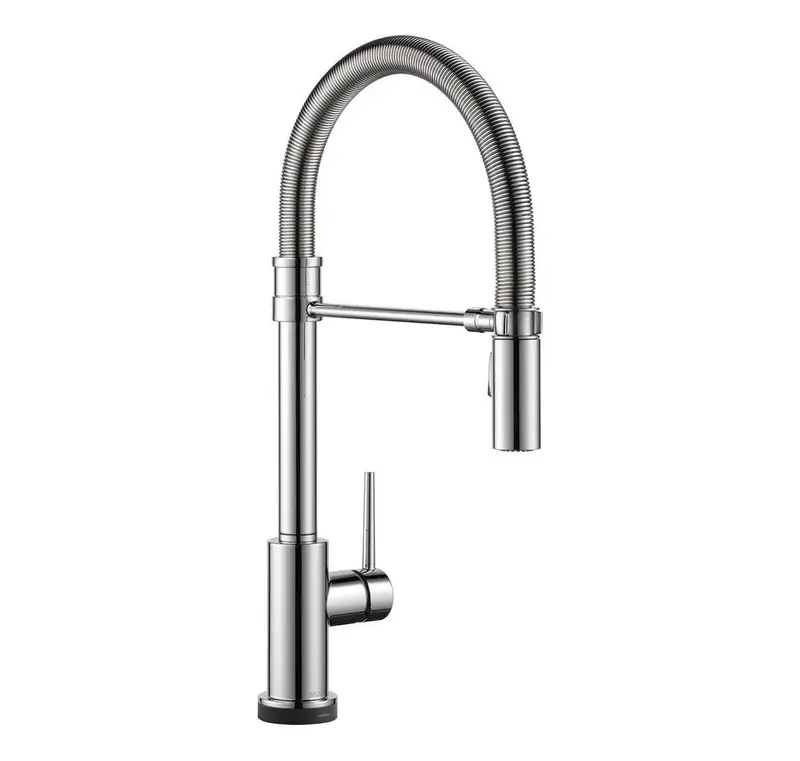
Delta Trinsic Touch2O Pull-Down Faucet
Touch anywhere to activate. Magnetic docking. Available in multiple finishes.
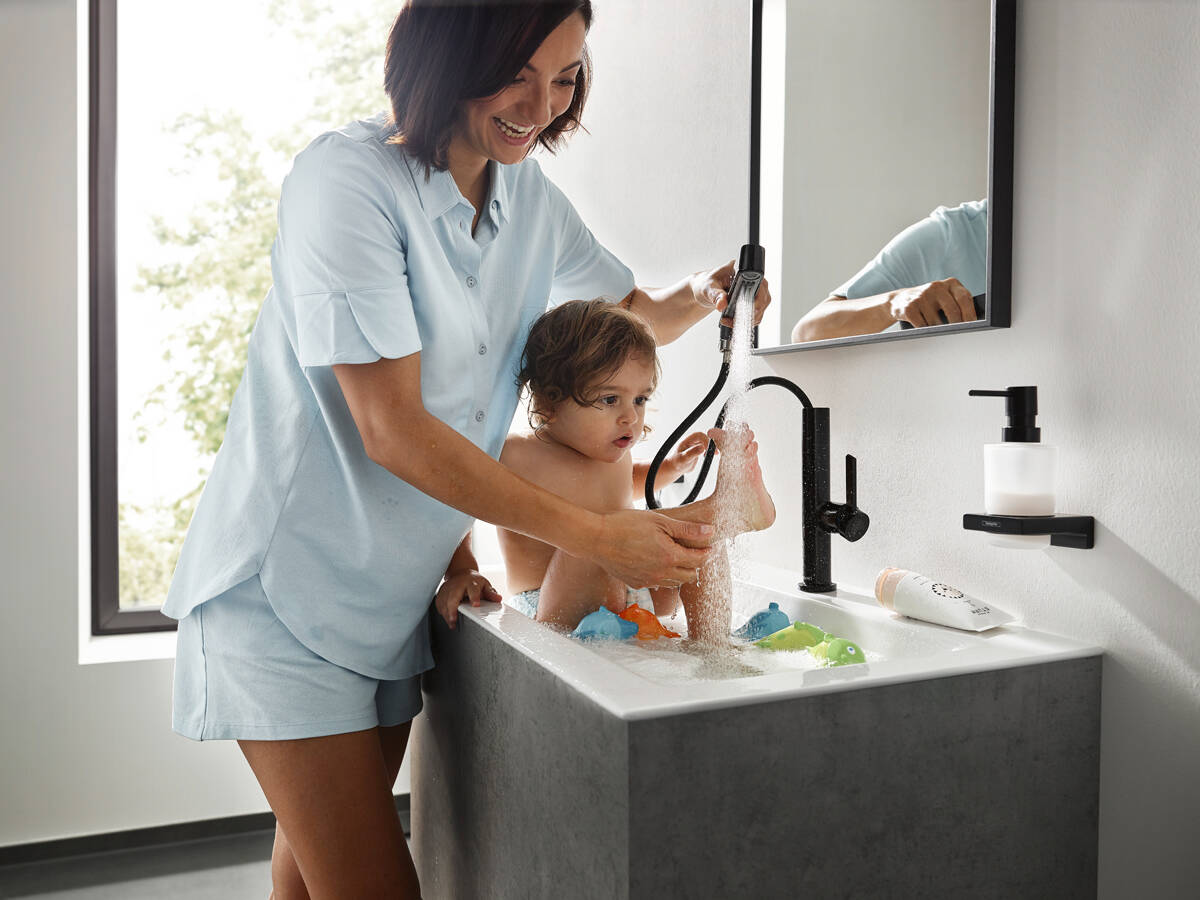
Hansgrohe Finoris Single-Hole Faucet 230 with 2-Spray Pull-Out
Single-hole with 2-spray pull-out (stream + rinse). Easy rinsing for limited mobility. 1.2 GPM, hard water resistant.
Best for: washing kids in the sink (aka universal design for ages 1–100)
Touch or motion? Touch faucets like the Trinsic are more predictable, which matters for anyone with a tremor: water runs only when they decide it should. Motion-sensor faucets work with a wave of the hand and suit hands that are messy or very weak. For the bathroom, I have used Kohler Composed faucets on client projects, usually the lever-handle version; its touchless model is covered in my touchless bathroom faucet guide.
What to check before you buy
Power. Most touch and motion faucets run on a battery pack mounted under the sink. Make sure someone can reach it to change batteries, or choose a model that offers an AC adapter if there is an outlet in the sink cabinet.
Temperature. Touch and motion faucets still use the handle to set temperature. Set it once at a comfortable warm position and leave it. For true scald protection, ask your plumber about an anti-scald or thermostatic mixing valve set to 120°F or lower.
Spout height and reach. A high arc spout lets you fill a pot that sits in the sink without lifting it. For anyone with weak wrists, that matters as much as the touchless feature.
Holes in the counter. Single-hole faucets are easiest to use one-handed. If you are replacing a three-hole faucet, check whether the model includes a deck plate, or order one, to cover the extra holes.
Docking sprayer. Look for a pull-down sprayer that docks itself magnetically, so it goes back with no fiddling from a tired hand. The Trinsic docks magnetically.
Touch, motion or a good lever: how to choose
Every faucet on this page still has a lever for temperature, so the lever matters even when the water turns on by touch or motion. Here is how I decide:
- Touch turns the water on and off with a tap of the wrist, forearm or the back of the hand anywhere on the spout. It is the best choice for arthritis and weak grip, because it never triggers by accident.
- Motion turns on when a hand passes a sensor and shuts off on its own. It is the best choice for memory loss, because water is never left running, but it can switch on when someone simply leans in to wipe the counter.
- A long single lever is the minimum for anyone, even with no electronics. The accessibility standard designers work to asks for controls that work with one hand, without tight grasping, pinching or twisting of the wrist. A lever you can push with a closed fist meets that; two small round knobs do not.
Set up the sink so the faucet is easy to reach
The best faucet is still hard to use if it sits too far back or too high. These are the installation details I put on the drawings:
- Put the faucet within easy reach. On a deep counter, mount the faucet to the side of the sink rather than dead center at the back, so the lever is reachable without leaning over the basin. Put it on the side of the person’s stronger hand.
- Choose the bowl depth for the person. A standard kitchen sink is deep, which means bending. For someone who cooks seated, accessible kitchen guidelines call for a sink rim no higher than 34 inches, a bowl no deeper than 6½ inches, and open knee space below, with the pipes insulated or covered so legs can’t touch hot drain lines.
- Get the spout over the center of the bowl. A spout that reaches the middle of the sink lets pots fill without being lifted, and a pull-down sprayer with enough hose to reach the far corners does the rest.
- Keep the battery pack and shut-off valves at the front of the sink cabinet, where they can be reached without kneeling and emptying the cabinet.
The design comes first
Neither of these faucets looks like medical equipment. That is the point. The best aging-in-place kitchen is one where the safer choice is also the more beautiful one, so nobody feels like the house has been adapted for them. Pick the finish and shape that suits the kitchen, then choose touch or motion based on the person who uses it.
Frequently asked questions
Are touchless kitchen faucets worth it for seniors?
For anyone with arthritis, a weak grip, or limited use of one hand, yes. Turning water on and off is one of the most repeated hand motions in a kitchen, and a touch or motion faucet removes the grip and twist from it entirely.
What is the difference between a touch and a touchless faucet?
A touch faucet like the Delta Trinsic Touch2O turns on when you tap anywhere on the spout or handle. A motion faucet turns on when you wave a hand near a sensor. Touch is more predictable for people with tremors; a wave sensor is better when hands are messy or very weak.
Do touchless faucets work when the power goes out?
Most run on a battery pack under the sink, and you can still use the handle manually if the batteries die. Keep a spare set of batteries in the kitchen.
Can a touchless faucet prevent scalding?
The faucet itself still delivers whatever temperature the handle is set to. For real scald protection, ask your plumber about an anti-scald or thermostatic mixing valve set to 120°F or lower.
Which is better for arthritis, touch or motion?
Touch. A tap with the wrist or back of the hand turns it on, it never runs by accident, and it takes no grip at all. Motion is the better choice when memory loss is the main concern, because it shuts itself off.
What height should a kitchen sink be for someone in a wheelchair?
Accessible kitchen guidelines call for the sink rim no higher than 34 inches above the floor, a bowl no deeper than 6½ inches, and open knee space below, with hot pipes insulated or covered.
Can I replace my faucet with a touch faucet without remodeling?
Usually, yes. Most touch faucets mount in a standard single hole, use the existing water lines, and add a small battery pack under the sink. If your sink has three holes, add a deck plate to cover the extra two.
Do touch and motion faucets need maintenance?
Change the batteries when the indicator light tells you to, and keep the sensor area clean. If the batteries run out, the lever still works as a normal manual faucet.
Related reading: Touchless bathroom faucets · Kitchen tools for a weak grip · Grab bars that don’t look institutional · The full collection