Aphasia After a Stroke: The Therapy and App That Actually Helped My Mom
After my mom’s stroke, I paid for a lot of speech therapists and downloaded what felt like every communication app on the App Store, trying to help her speak again. Most of it didn’t help. Only two things actually moved the needle: The Aphasia Center and an app called APP2Speak.
My mom has aphasia and severe apraxia of speech. She understands far more than she can say. She knows exactly what she wants, but the word comes out wrong, or doesn’t come out at all. If you love someone with aphasia, you know how isolating that is for both of you. Here is what worked for us, why I think it worked, and how to get started.
| What helped | What it does | Who it’s for |
|---|---|---|
| The Aphasia Center | Intensive aphasia therapy, onsite in St. Petersburg, FL or online at home | Rebuilding speech, reading and writing |
| APP2Speak | A photo-based speech app: tap a picture, the phone says the word | Asking for what you want now, while speech is still hard |
What didn’t work: the insurance-covered speech device
One of the most expensive things we tried was a dedicated speech-generating device, basically a badly designed version of an iPad that only does one thing: aphasia communication. Insurance covered it, which is why so many families end up with one. It came with a clunky app where you’re supposed to log in everything she might want to say.
Honestly, it was a burdensome waste of time and money. The device was heavy and awkward to carry, the app was hard to set up and harder to use, and in real life it didn’t help my mom communicate. Being covered by insurance doesn’t make a device helpful. If someone hands you one, ask whether an app on the phone your loved one already carries could do the job better. For us, it could.
What the two that worked have in common
Looking back at everything we tried, the two that worked share two things: a lot of practice in a short time, and her own real-life words. Not a generic word list, but the drinks she likes, the names of the people she loves, and the food actually served where she lives.
The Aphasia Center: intensive therapy that teaches words the way a child learns them
The Aphasia Center in St. Petersburg, Florida runs intensive aphasia therapy programs, founded by aphasia researcher Dr. Lori Bartels-Tobin, PhD, CCC-SLP. My mom did their six-week intensive program. Instead of an hour a week, it’s hours of therapy every day.
The method is simple, and it’s the way any child learns a new word: see the picture, hear the word, watch the mouth, say it, then write it. Every word is practiced in more than one way at once, which therapists call multimodal communication. In my mom’s sessions that looked like:
- Pictures and words together: a photo of water, the written word “water,” and the therapist saying it.
- “Watch my mouth”: with apraxia, getting the first sound started is the hardest part, so seeing the mouth shape helps.
- Finishing the sentence: the therapist says “For lunch, you ate…” and my mom fills in “tacos.”
- Writing it out: copying a word twice, then writing it from memory. Scrabble-style letter tiles made this feel like a game.
- Memory-match games and pronunciation videos she could repeat on her own.
- Her own words: my dad’s name, tea, salad, water. Words she uses every single day, not workbook vocabulary.
The progress was real. On day one she needed to hear the word, see it written and watch the therapist’s mouth all at once just to say a single word. By the end, she could say words she’d practiced with only a small hint. She also started writing words on her own again, including her name and my dad’s.
We also came home with a written plan: how to talk with her (slow down, write down key words, offer three choices), a home practice program, and access to My Aphasia Coach, the center’s software for daily practice. The best line in her report, and the one I hold onto: “There is no plateau in aphasia recovery.” With the right practice, people keep improving.
If you can’t travel, The Aphasia Center also offers online and hybrid intensive programs you can do from home. Call 727-823-2529 for current pricing and a consultation.
APP2Speak: the app that lets my mom order her own meals
Therapy rebuilds speech over time. But my mom needs to eat today. That’s where APP2Speak comes in.
APP2Speak is an AAC app (augmentative and alternative communication) created by St. Louis speech-language pathologist Gina Baldwin, M.S., CCC-SLP. It’s photo-based: you tap a picture or word and the phone says it out loud. The part that changed everything for us is the custom pages.
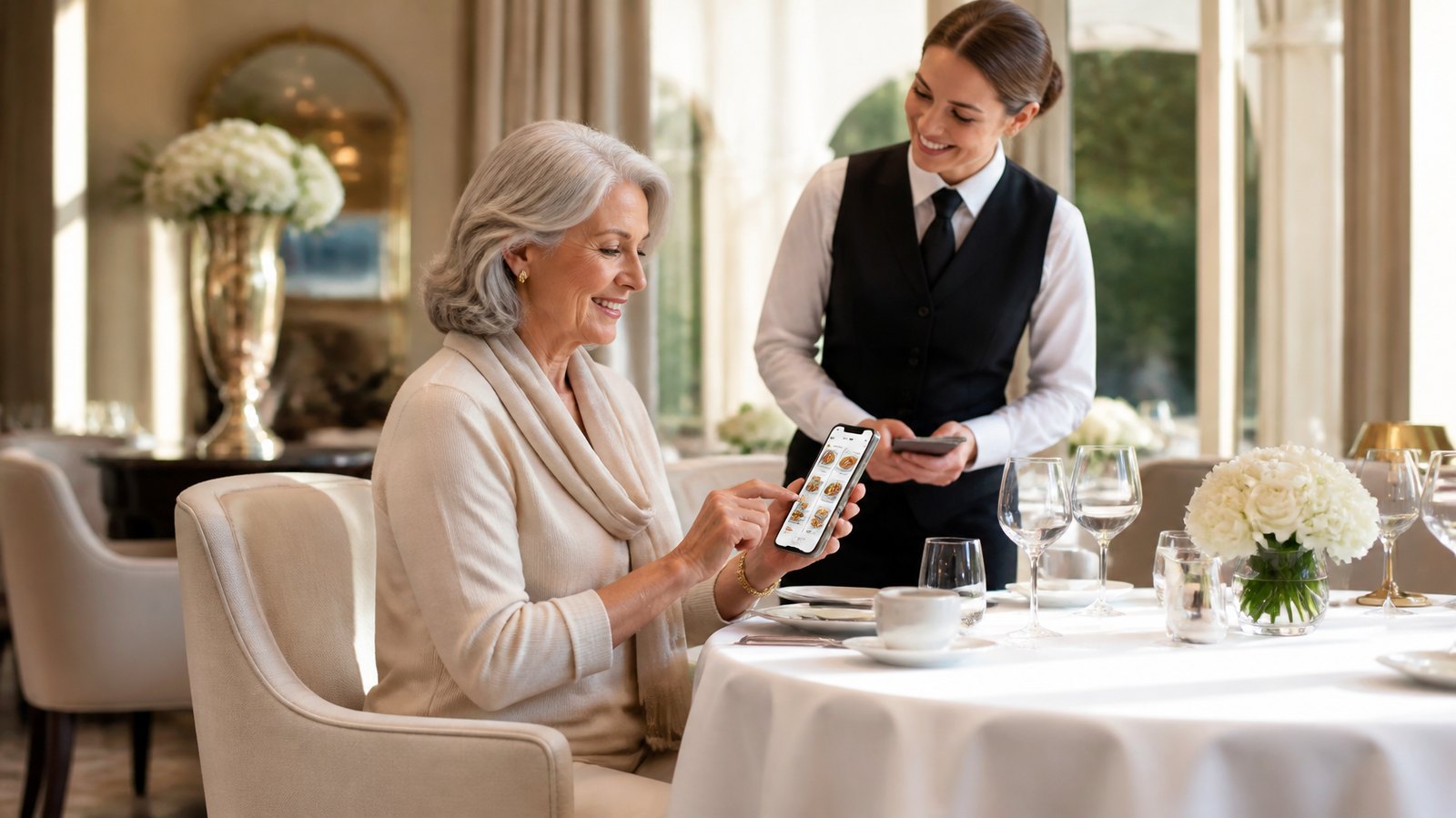
One of my mom’s therapists entered every food item served at her assisted living community into the app. Now when staff come to ask what she’d like to eat, she opens her phone and taps exactly what she wants, or points to it on the menu. She doesn’t have to struggle through words that still won’t come, and nobody has to guess. She gets the meal she actually wanted.
Best of all, it’s on the iPhone she already carries everywhere, so her voice is always with her. There’s no extra device to remember, carry or charge.
That sounds small. It isn’t. Choosing your own food three times a day is dignity and independence, and it’s one less place where aphasia decides for her.
APP2Speak is a one-time purchase (about $199 on the App Store, no subscription) and works on iPhone, iPad and Android. Custom pages can be shared to another device over Bluetooth or WiFi, so keep a backup copy on a family member’s phone in case hers is ever lost or replaced.
 Used in our family
The Aphasia Center
Intensive aphasia therapy, onsite in St. Petersburg, FL, online, or hybrid. Words are taught through pictures, hearing, watching the mouth, saying and writing.
The Aphasia Center → Used in our family
APP2Speak
Photo-based speech app made by a St. Louis speech pathologist. Build custom pages, like a facility’s full menu, so she can tap to order.
App Store →How to use both together
- Get an intensive therapy consultation. Ask about onsite, online and hybrid programs, and do as much as you can afford in a concentrated block.
- Ask the speech therapist to build APP2Speak pages around real life: the dining menu where she lives, family names, favorite drinks, “I’m cold,” “I need help.”
- Practice the same words in therapy and in the app. When she taps “tea,” encourage her to try saying “tea” too. The app is a bridge, not a replacement for speaking.
- Write things down when you talk with her. Key words, three choices, a pen always nearby.
- Update the app when the menu changes, and keep a backup copy on your own phone.
If your loved one is still at home, small design changes support all of this too. See how to make a home safer after a stroke. If you’re weighing next steps for care, read how to choose assisted living in St. Louis. The National Aphasia Association is also a good place to learn more.
Everything I recommend, in one place
Both of these are now in my full collection, alongside every product I specify for aging in place.
See the Full CollectionFrequently asked questions
What is the best app for aphasia after a stroke?
For my mom, APP2Speak was the one that worked, because it’s photo-based and fully customizable. Her therapist loaded her real daily words, including every meal at her facility. The best app is the one built around the person’s own words and routines, so ask a speech-language pathologist to set it up.
What is intensive aphasia therapy?
Intensive aphasia therapy packs many hours of speech therapy into a few weeks, often several hours a day, instead of one session a week. The Aphasia Center offers onsite, online and hybrid intensive programs.
Can someone with aphasia still improve years after a stroke?
Yes. My mom’s therapists put it plainly: there is no plateau in aphasia recovery. With consistent practice and the right support, people continue to improve.
What is an AAC app?
AAC stands for augmentative and alternative communication. An AAC app lets someone tap pictures or words so the device speaks for them. It supports communication while speech is still difficult.
How can people with aphasia order food in assisted living or restaurants?
A customized AAC app like APP2Speak can hold photo buttons for every menu item, so the person taps what they want and the phone says it. Pointing to a written menu works too. Both let them choose for themselves.
Are insurance-covered speech devices for aphasia worth it?
Not in our experience. My mom’s insurance-covered speech device was heavy, clunky and came with an app that was hard to set up and use. A customizable AAC app on the phone she already carries, set up with her own words, helped far more.
The bottom line
After all the money and all the apps, what helped my mom was simple: lots of practice with her own words, and a way to ask for what she wants today. The Aphasia Center gave her words back, one at a time. APP2Speak gave her a voice at the dinner table while the rest of the words are still coming.