Designing a Curbless Shower That Doesn’t Look Like a Hospital: The AXOR Starck Spec
Every renovation I take on for a client planning to stay in their home starts with the same tension in the room. Someone says the word “accessible” and someone else pictures a grab bar bolted to a tile wall like an afterthought, a plastic bench, a showerhead that looks like it belongs in a rehab facility. I understand the flinch. Most of what gets marketed as “aging in place” was designed by people solving for liability, not for how a room actually feels at seven in the morning.
I’ve spent fifteen years specifying bathrooms for House Beautiful features and quiet, well-heeled primary suites, and for the last several years I’ve also been the person helping my own parents navigate a house that no longer quite fits them. Those two jobs taught me the same lesson from opposite directions: safety and beauty were never actually in conflict. The conflict is between good design and cheap design. A curbless shower with the right materials, the right fixture, and the right sequencing of decisions can look like something out of a design magazine and still hold up a person who needs to trust the floor under their feet. This is the spec I use to get there.
What Actually Makes a Shower Safe for Aging in Place
Before we get to any single fixture, it’s worth being precise about what “safe” is doing structurally, because most of it is invisible once the room is finished.
Curbless entry
A zero-threshold shower removes the single biggest fall risk in the bathroom: the step over the curb, usually taken while wet, often while turning. It also happens to be the detail that makes a shower read as architecture rather than accommodation. A flush plane between the shower and the rest of the floor, achieved with a linear drain and a slightly sloped substrate (generally around a quarter inch of fall per foot toward the drain), looks like a hotel spa. It also happens to work for a walker, a wheeled shower chair, or someone who just doesn’t trust their balance on a lip anymore.
Non-slip flooring, chosen for coefficient of friction, not just looks
This is where I see the most well-intentioned bathrooms fail. A beautiful large-format porcelain tile with a glossy or semi-polished finish can be genuinely dangerous wet. I spec matte or textured porcelain with a wet-rated slip resistance, small-format mosaic (two-inch hexagon or smaller) on shower floors specifically because more grout lines mean more traction, and I stay away from natural stone that hasn’t been honed and sealed for slip resistance. None of this has to look institutional. Some of the most elegant shower floors I’ve specified are unglazed clay-body mosaics in warm neutrals that nobody would guess were chosen for friction first.
Integrated seating, not a fold-down accessory
A built-in bench, whether it’s a full curb-to-wall bench, a floating teak-look porcelain shelf, or a niche bench poured into the pan, gives someone a place to sit while washing, shaving, or simply resting without the room announcing that a shower chair lives here. I like these detailed the same way I’d detail a window seat: waterfall edge, matching or complementary stone or tile, integrated at the design stage rather than retrofitted.
Grab bar placement that reads as a towel bar or shelf
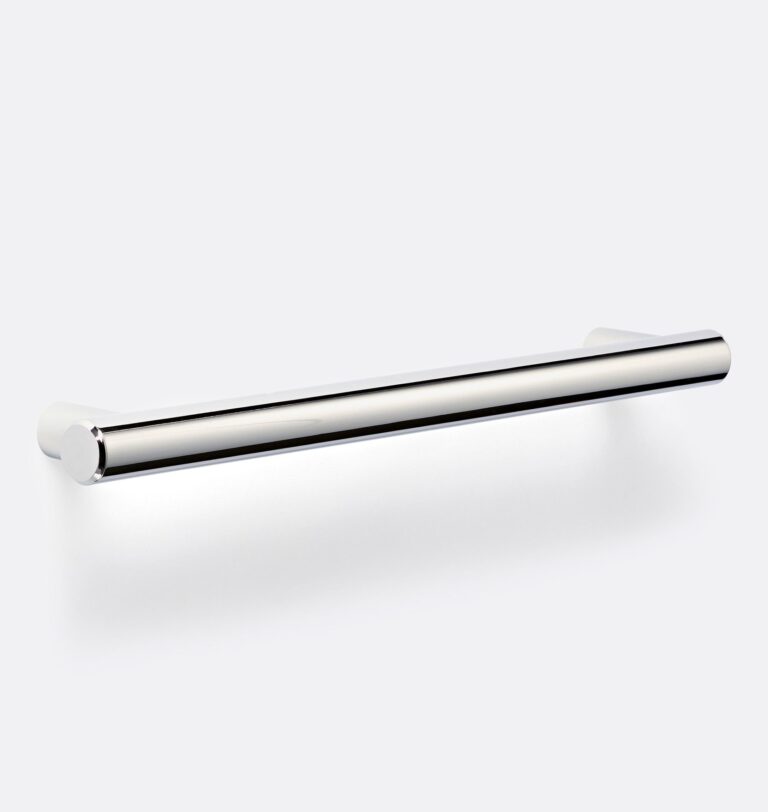
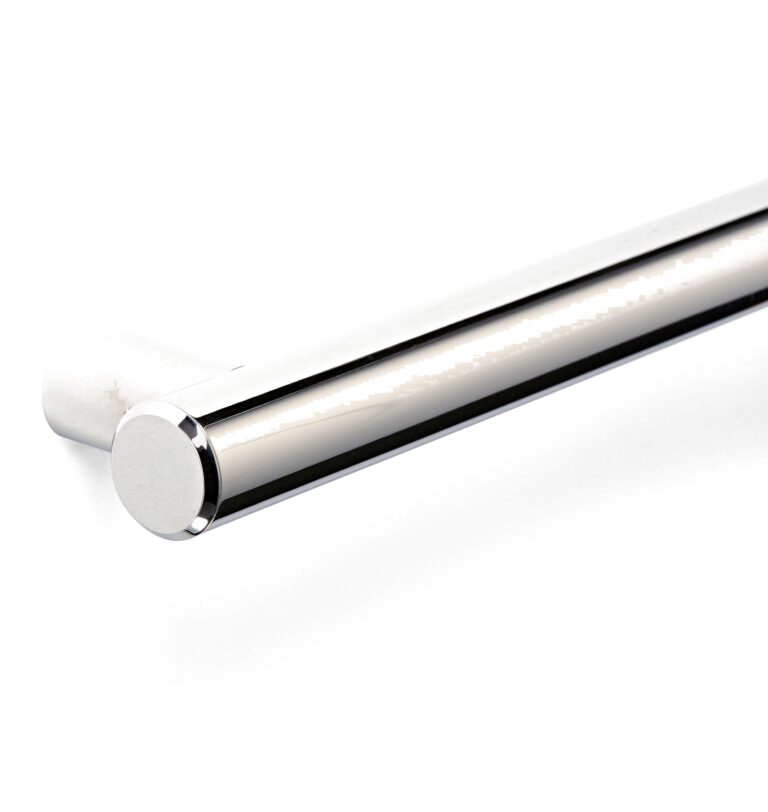
Structurally, this comes down to blocking. I have contractors install continuous plywood or 2x backing behind the entire wet wall during framing, whether or not grab bars go in on day one, because retrofitting solid blocking after tile is set is expensive and disruptive. Placement generally follows the range most accessibility guidelines recommend, bars mounted roughly 33 to 36 inches above the floor, positioned along the control wall and the entry wall where someone would actually reach for support. The bars themselves don’t have to look clinical. There are now genuinely handsome options in the same finishes as the plumbing, knurled brass, matte black, brushed nickel, that double as a towel bar or a shelf bracket. Nobody walks into a bathroom with a well-finished grab bar and thinks “hospital.” They think “considered.”
Thermostatic controls for scald protection
This is the piece people underestimate, and it’s the one I want to spend the most time on, because it’s where the fixture itself does real safety work rather than just structural work.
Rachel’s Pick: The AXOR Starck Showerpipe 240
For the shower system itself, I specify the AXOR Starck Showerpipe 240. It’s a German-engineered fixture from Hansgrohe’s design-forward AXOR line, developed with Philippe Starck, and it’s the single fixture I return to most often on projects where I need the shower to function like a safety system while looking like sculpture.
- Price: retail typically runs from roughly $2,800 up into the $4,000-plus range depending on finish, retailer, and whether the thermostatic rough-in valve is bundled or purchased separately. Chrome is the baseline finish; brushed and matte finishes cost more.
- Overhead spray: AXOR’s PowderRain technology, which atomizes water into extremely fine droplets for a softer, more enveloping spray pattern than a standard rain shower. It reads as luxury in the showroom, but it also lands gentler on skin that’s become more sensitive with age.
- Flow rate: available in a WaterSense-certified 1.75 GPM configuration and a higher-volume 2.5 GPM version, both measured at standard test pressure, so you can choose based on your water heater capacity and local code without sacrificing the spray experience.
- Thermostatic control: the showerpipe integrates a thermostatic mixer with a built-in safety stop, engineered with backflow prevention, that keeps output temperature steady and capped, so a pressure fluctuation elsewhere in the house, someone flushing a toilet, a dishwasher kicking on, doesn’t translate into a scalding surprise mid-shower.
- QuickClean nozzles: the spray discs are flexible silicone, so mineral buildup wipes away with a fingertip instead of a scrub brush or descaling chemical, which matters for long-term maintenance in a fixture meant to perform for decades.
- Finish options: chrome, plus AXOR’s broader finish palette, including brushed nickel, stainless steel, and matte black, which is how I match it to the rest of a room’s hardware rather than letting the shower fixture look bolted on from a different design language.
- Install requirements: wall-mounted, requiring a dedicated thermostatic rough-in valve set into the wall during framing, which is precisely why this decision needs to happen at the design stage rather than as a swap-in later. Professional installation is recommended and, frankly, necessary given the plumbing behind the wall.
Here’s why the thermostatic function earns it a place on my list beyond the finish and the spray pattern. As skin ages, it thins and loses some of its capacity to register temperature quickly, which means a shower that feels merely warm can already be doing damage. Research on home hot water safety has found that water at 120°F, a temperature plenty of water heaters are set to or above, can cause a serious burn in roughly ten minutes, and at 140°F that drops to seconds. A thermostatic valve with a hard safety stop takes that risk out of the equation entirely. It’s not a feature I’m recommending because it sounds responsible. It’s the actual mechanism that prevents the injury.
How to Integrate It Without It Reading as Medical Equipment
The trick to a curbless shower that doesn’t look institutional is sequencing: decide the safety infrastructure first, then let the finishes do the talking.
- Match metals intentionally. I run the AXOR Starck’s finish through the whole wet wall, on the grab bars, the niche trim, the door hardware if there is one, so the room reads as one considered palette instead of a fixture and a set of add-ons.
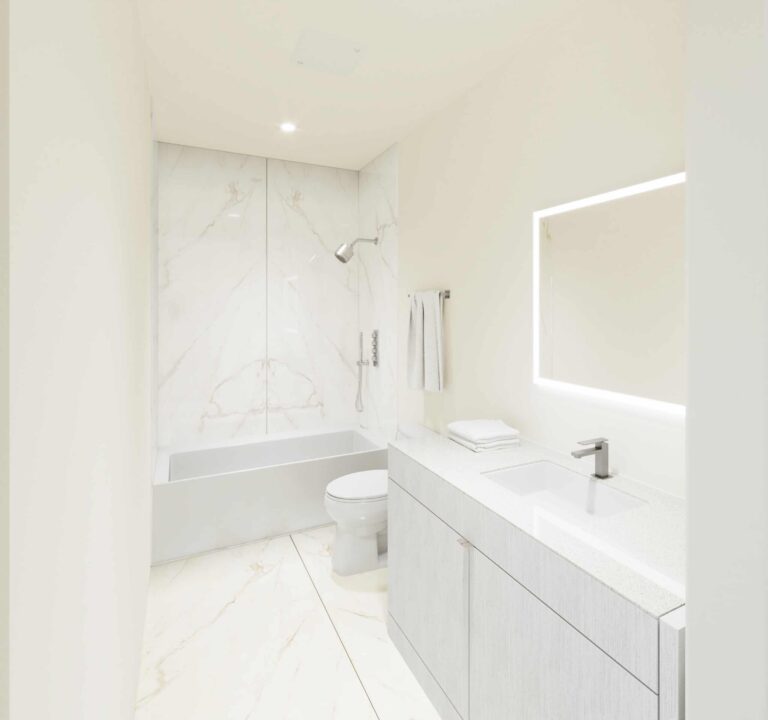
- Let the tile carry the design statement. With a slim, architectural showerpipe like the Starck 240, the wall becomes the visual anchor. A book-matched stone slab or a warm plaster-look large-format tile does more to set the tone of the room than any fixture could.
- Keep the glass minimal or skip it. A fully open curbless shower with no enclosure, or a single fixed panel, keeps sightlines clean and avoids the boxed-in feeling that reads as clinical. It also removes another fall hazard: a door track or frame someone has to navigate around.
- Light it like the rest of the house. Warm-temperature recessed lighting or a single well-placed sconce does more to make a shower feel residential than any material choice. Harsh, cool-white overhead light is what makes a bathroom feel like a facility.
Done this way, the accessibility features disappear into the architecture. Guests don’t clock the grab bar. They notice the stone, the light, the sound of water falling softly instead of spraying hard. That’s the whole point.
A Low-Pressure Closing Thought
You don’t have to make every one of these decisions at once, and you don’t have to spend Starck-level money to build a safer shower. But if you’re already renovating, already opening the walls, the cost difference between a standard valve and a thermostatic one, between a curb and a curbless pan, is smaller than people expect, and it’s the kind of decision that’s expensive to undo later. I’d rather spec it once, well, than retrofit it under worse circumstances. If you’re weighing this for your own home or a parent’s, I’m always happy to talk through what the room can hold.