Universal Design Kitchen, St. Louis
Storage, clearances, cooktop safety and the products I specify — a kitchen designed to work from age one to one hundred, without looking like it was designed for anyone in particular.
I design homes as an interior designer, and I have two disabled parents, so by default I am good at aging in place.
My father’s independence turned out to be mental and financial, not physical — the most useful things I ever set up for him were a robot mop vac, a maid, a lawn service, a cheap computer, and a high-yield savings account. None of which appears on typical checklists. Know what problems you need to reduce before you renovate anything. No-maintenance living in a condo with amenities, or an assisted living community, could make life easier and solve multiple issues at once, quickly.
A kitchen should work from age 1 to 100
A drawer a four-year-old can open is a drawer an eighty-year-old can open. A counter you can work at seated is a counter you can work at after knee surgery, or while pregnant, or at the end of a long day. Front controls on a cooktop mean nobody reaches across a hot burner, at any age. That’s universal design, and it’s what all of us should be doing as a matter of course.
The problem that’s specific to your kitchen
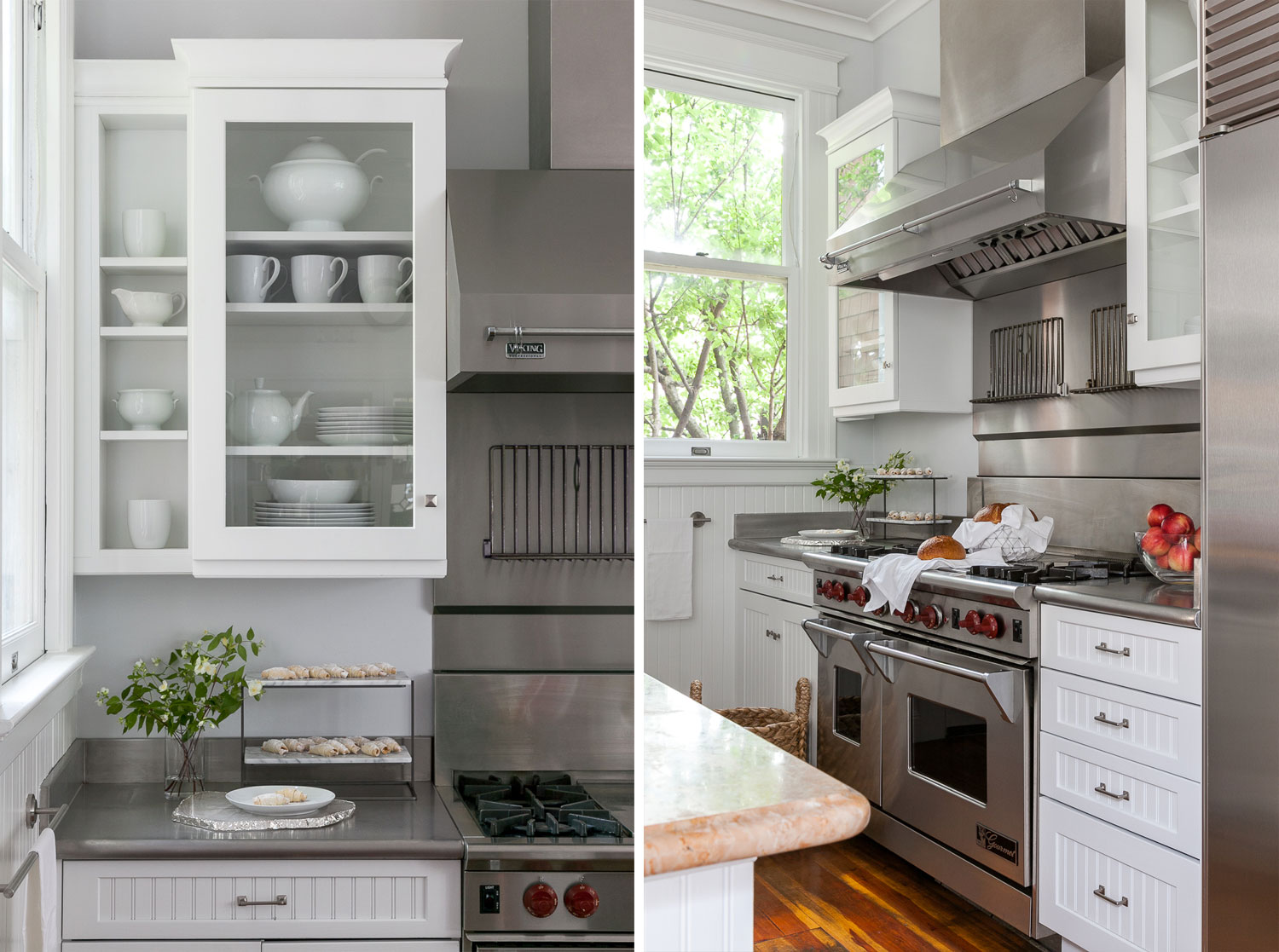
In the large mid-century ranches through Frontenac, Town and Country, and Creve Coeur, the kitchen often opens straight onto a sunken family room — a wide step-down that’s easy to cross today and a real obstacle in ten years. In the older colonials around Ladue, Clayton, Webster Groves, and Kirkwood, the constraint is usually clearance: a narrower galley layout, a single run of upper cabinets built for standing reach only, storage that requires a step stool for anything used daily.
Fixing either well means looking at your actual floor plan — where the step is, how much clear floor space exists at the sink and stove, whether a section of counter can vary in height without breaking up the cabinetry run.
Cooking fires
Cooking is the leading cause of home fires, and the risk rises with age and cognitive change. A heat-sensor shutoff system like Stove Guard, about $300, cuts power to the range before a fire starts and learns your household’s cooking patterns. The radar-based iGuardStove, around $150, cuts power after several minutes with nobody in the kitchen and alerts a caregiver. I specify one of them in every kitchen for someone aging at home.
Induction is best for small kitchens, and a wheelchair can fit underneath if needed. Gas is best for actual cooking.
A touch-activated faucet like the Delta Trinsic Touch2O, around $325, starts the water with an elbow or a wrist when both hands are full or arthritic. A workstation sink with an integrated cutting board and colander cuts the lifting, bending, and carrying food prep requires. All of it, with prices, is in the full recommendation list. The bathroom specification guide covers the equivalent product tiers for baths.
Working together
I’m caring for my own parents full time, so I take on very few projects right now. If there’s a specific problem in your kitchen you’re trying to solve, email hello@wellaginghome.com and tell me about it. I’ll tell you honestly whether I’m the right person for it and whether I have room.
Every Chapter.
My room-by-room guide to a home that works from age one to one hundred. The kitchen chapter covers storage, lighting, hardware, faucets, and flooring, with the products I’d specify for my own family.
Send me the free guideServing Greater St. Louis — Ladue, Clayton, Frontenac, Town and Country, Creve Coeur, Des Peres, Chesterfield, Wildwood, Kirkwood, and Webster Groves. Consultations are virtual, so location is flexible.