Is Home Care Cheaper Than Assisted Living? One Family’s Actual Numbers
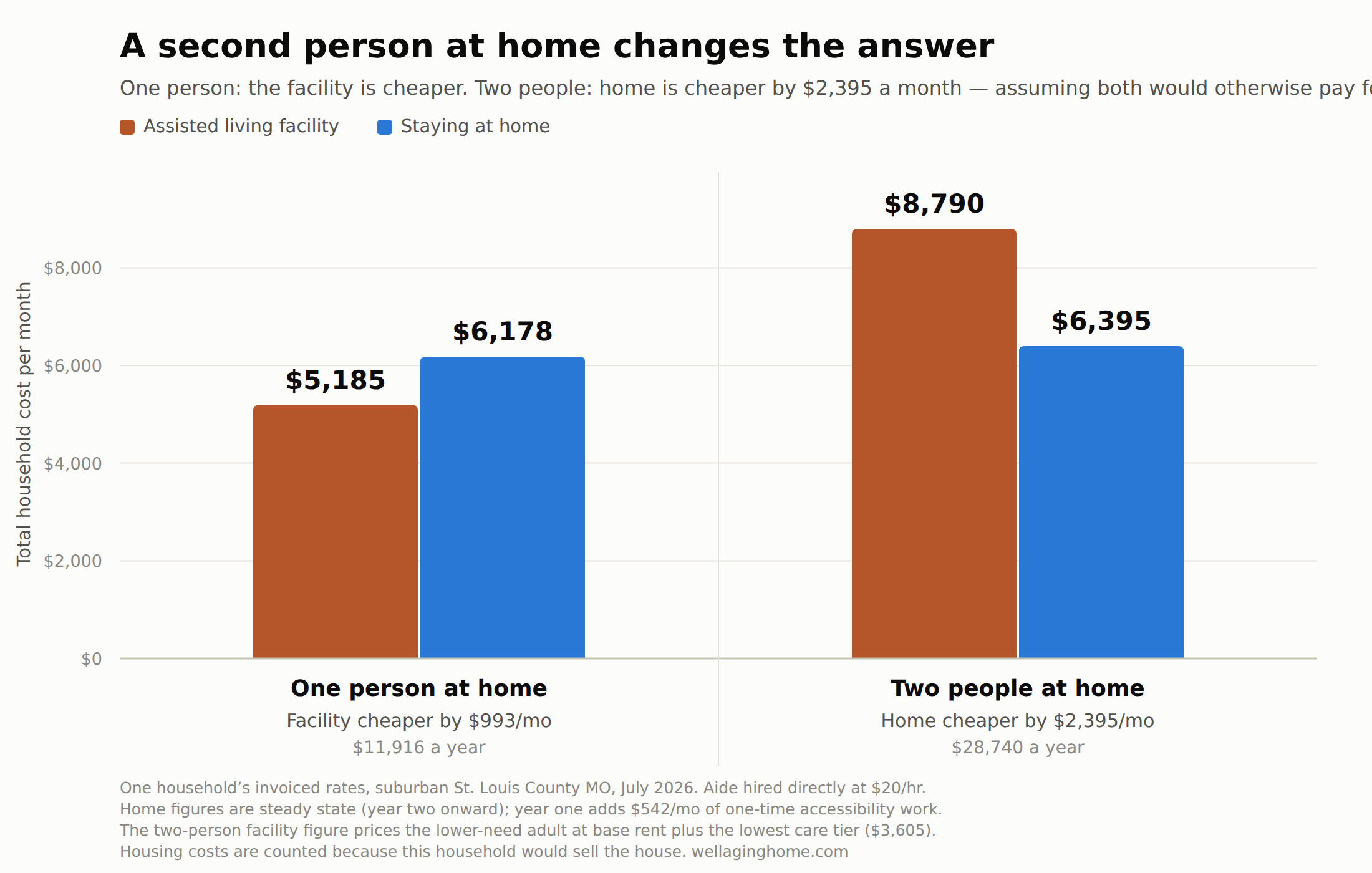
For one person, assisted living is usually cheaper. For two people in the same house, home care usually wins — by about $2,400 a month. The reason is structural: roughly 86% of what home care costs does not change when you add a second person. The house is already there. The aide is already on shift.
In this household’s actual invoices, the break-even lands at 1.29 people. Put humanly: home care starts winning the moment there is more than one person to care for.
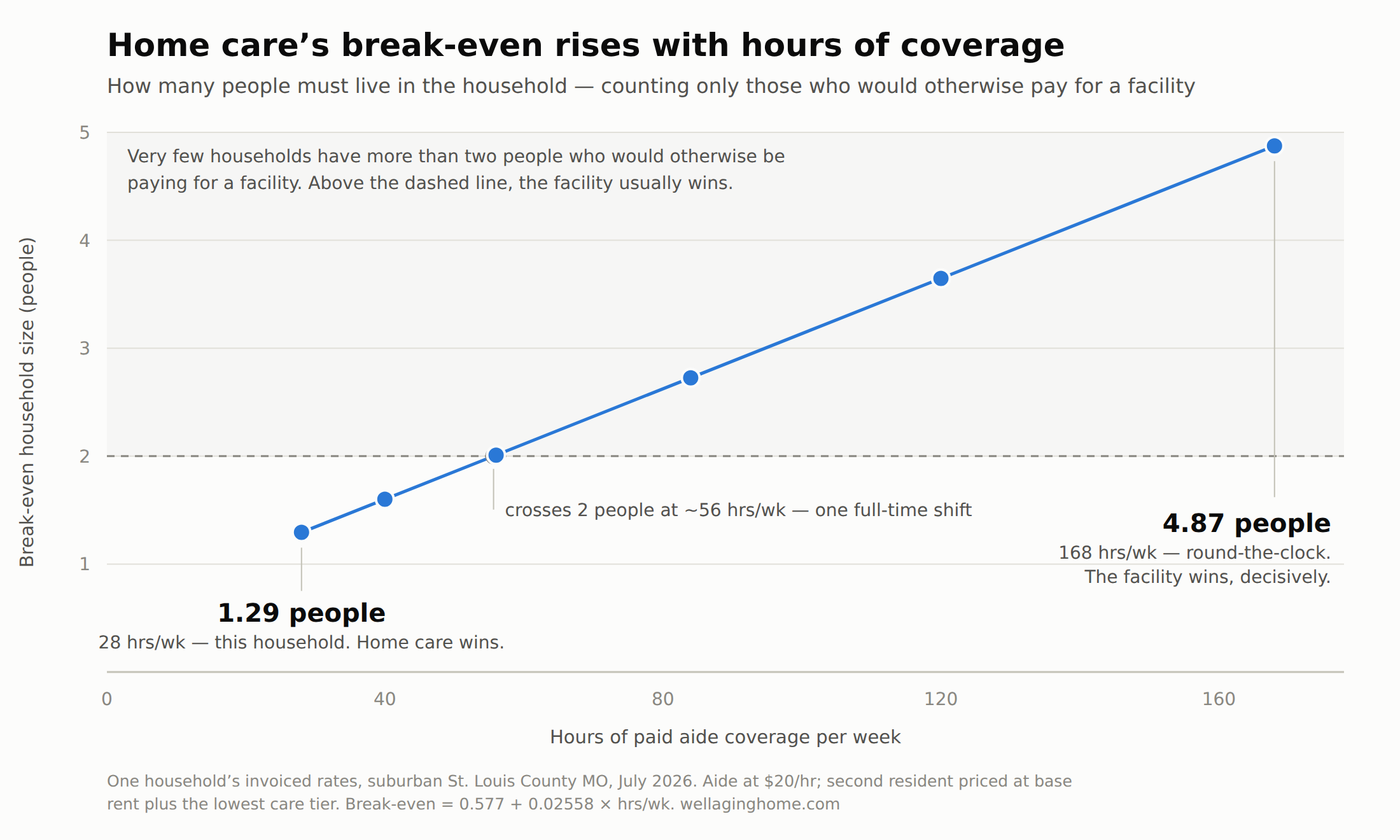
But 1.29 is not a constant. It is the break-even at 28 hours a week of paid coverage. Raise the hours and the break-even climbs fast — which is the part almost nobody models, and the reason every article on this question seems to contradict every other one.
Last updated 26 July 2026. These are one family’s real invoices from suburban St. Louis County, Missouri — not a national average. Assumptions and methodology are stated in full below.
Correction, 26 July 2026: this break-even was originally published as 1.16 people, and the coverage table and chart were built on that figure. That calculation priced a second resident at the full $5,185 facility rate, which contradicts the $8,790 two-person figure used elsewhere in this piece, and it averaged the two residents’ variable costs instead of using the $687 and $217 splits above. Recomputed against this household’s own invoices, the break-even is 1.29 people and it passes two people at about 56 hours a week rather than 74. The finding is unchanged — it still sits just above one person — and the downloadable model has been rebuilt to match.
What this page covers
- The break-even is a line, not a number
- Where this thesis loses: round-the-clock care
- Side one: what the facility actually cost
- A quoted rate is a base rate
- Side two: what home care actually cost
- The costs people leave out
- One honest note on the caregiver wage
- Rates vary enormously by state
- If either person is a veteran
- Assumptions and methodology
- What I am not
- Common questions
- Run your own numbers
The break-even is a line, not a number
Almost all of home care’s fixed cost is the staffed shift. So as coverage hours rise, the fixed base rises with them, and more people are needed in the house to spread it across. The relationship turns out to be exactly linear:
break-even people = 0.577 + 0.02558 × hours of paid coverage per week
| Paid coverage | Aide cost/mo | Home fixed cost | Break-even |
|---|---|---|---|
| 28 hrs/wk (this household) | $2,427 | $5,491 | 1.29 people |
| 40 hrs/wk | $3,467 | $6,532 | 1.60 |
| 56 hrs/wk (8 hrs/day) | $4,853 | $7,918 | 2.01 |
| 84 hrs/wk (12 hrs/day) | $7,280 | $10,345 | 2.73 |
| 168 hrs/wk (24/7) | $14,560 | $17,625 | 4.87 people |
The break-even passes two people at about 56 hours a week. Below that, a two-person household is on the winning side. Above it, very few households have more than two people who would otherwise be paying for a facility, so the facility usually wins.
Where this thesis loses: round-the-clock care
At 24/7 coverage, home care loses decisively, and it is worth saying so plainly.
Round-the-clock is 168 hours a week. At this household’s $20/hour that is $14,560 a month in aide wages alone — before housing, food, medication, or anything else. Carried through the model exactly as built — every other line held constant — total home cost for one person is $18,312 against a facility’s $5,185. The facility is cheaper by roughly $13,100 a month.
That comparison is harsher than it needs to be, because round-the-clock professional coverage would replace both the family caregiver wage ($1,500) and the medication aide ($234) entirely. Zero those two lines and home care comes to $16,577 — still about $11,400 a month more than the facility — and the break-even falls from the 4.87 people in the table above to 4.43. At the 2026 national median of about $34/hour for agency care, 24/7 runs closer to $24,700 a month in wages and the break-even passes seven people. Whichever way it is counted, you would need three, four, or seven people in the house. That effectively never happens.
If the honest answer to “how many hours does this person need someone present” is “all of them,” the arithmetic has already decided, and the rest of this page is not your situation.
Side one: what the facility actually cost
| Line item | Monthly |
|---|---|
| Base rent, one-bedroom unit | $3,105 |
| Care level 2 | $1,000 |
| Medication management, level 3 | $450 |
| Quoted monthly total | $4,555 |
| Guest meals (~2/month) | $30 |
| Private caregiver hired on top | $600 |
| True all-in cost | $5,185 |
That $600 line deserves an explanation, because it is the one people leave out and the one I would tell you not to cut.
I paid a private caregiver out of pocket, on top of the facility bill, for hours the facility did not cover. She was the reason my mother did well there. I stopped when I could not afford it any more. Nothing about the billed care level changed when she left; what changed was everything the invoice does not measure.
If you are comparing a facility quote against a home budget, the honest facility number includes whatever you will end up paying to close the gap between the care level billed and the attention actually needed. Most families pay some version of it.
A quoted rate is a base rate
Most assisted living communities price in tiers: base rent for the apartment, plus a care-level charge that scales with assessed need, plus medication management billed separately. The brochure number is the base. The invoice number is the base plus everything else, and the everything-else is reassessed periodically at the community’s discretion.
In this household’s case, over roughly five months:
- Base rent rose from $2,930 to $3,105 — a 6% increase, delivered by letter with a countersignature deadline.
- The care level moved from 1 to 2, taking that line from $500 to $1,000. A 100% increase — applied despite the resident’s assessed care points going down, not up.
- Medication management was billed at level 4 ($600) for nearly four months before being corrected to level 3 ($450), producing a $551.61 credit the family had to identify and request.
None of this is unusual, and none of it is necessarily improper. It is how the pricing model works. But it means a facility quote is not a fixed cost you can plan a decade around — it is a starting point with a variable attached, and the variable moves in one direction more often than the other. Model the care-level line as a range, not a number.
Side two: what home care actually cost
The full monthly build for both adults at home, split into costs that stay flat regardless of headcount and costs that attach to a specific person.
Fixed — shared by the household
| Property tax | $200 |
| Homeowners insurance | $125 |
| Utilities | $350 |
| Internet and phone | $80 |
| Home maintenance reserve | $150 |
| Companion aide, 20 hrs/week @ $20 | $1,733 |
| Weekend/evening coverage, 8 hrs/week @ $20 | $693 |
| Family caregiver wage, 75 hrs/month @ $20 | $1,500 |
| Weekly cleaning service | $500 |
| Exterior maintenance and yard | $160 |
| Fixed subtotal | $5,491 |
Variable — attaches to a person
| Adult day program, 2 days/week @ $60 | $480 |
| Medication aide, 3 hrs/week @ $18 | $234 |
| Backup weekend meal service | $100 |
| Medical alert monitoring, two people | $40 |
| Podiatry and foot care | $30 |
| Craft and activity supplies | $20 |
| Variable subtotal | $904 |
Two people at home: $6,395/month. Of that, $5,491 — about 86% — is fixed. The marginal cost of the second person is roughly $217 a month for the lower-need adult and $687 for the higher-need one.
Groceries are $0 because SNAP plus a Medicare Advantage healthy-food benefit covered them, and the aide prepares meals during her existing shift. That is the single assumption most worth testing against your own situation, because facility rent includes meals. Add $600 a month for two people and the break-even moves from 1.29 to 1.47 — still just above one person. Transportation is $0 because the aide drives — which is why “must have a reliable car” was a hard requirement in the job posting, not a preference.
The head-to-head
| At home | Facility | Difference | |
|---|---|---|---|
| One person | $6,178 | $5,185 | Facility cheaper by $993/mo ($11,916/yr) |
| Two people | $6,395 | $8,790 | Home cheaper by $2,395/mo ($28,740/yr) |
The two-person facility figure assumes the second, lower-need adult pays base rent plus the lowest care tier — $3,605. That is deliberately conservative. If both were assessed at the level this household actually paid, the facility side is $10,370 and home care wins by $3,975 a month.
The costs people leave out
Most comparisons online quote an hourly aide rate, multiply by 40, and stop. That is not a budget. These get omitted, and all of them are real:
- Family caregiver labour. The largest single omission. If a family member is doing 75+ hours a month of scheduling, transport, advocacy and hands-on care, that is a cost whether or not anyone writes a cheque. At $20/hour it is $1,500 a month, and it is the line that most often turns a “cheap” home plan into an unsustainable one. This model prices it in and still logs more actual hours than it pays for.
- Household services. Cleaning, laundry, yard, exterior maintenance — $660 a month here. Bundled invisibly into facility rent; at home, someone has to hire and manage the people doing them.
- Transportation. Appointments need a driver, and for anyone who cannot self-advocate, a driver who stays in the room. Either a line item or a hidden claim on a family member’s workday.
- Adult day programs. $480 a month for two days a week. Not optional in any real sense — it is the social and cognitive engagement a facility provides structurally and a house does not. Omitting it makes home care look cheaper than it is, and worse than it should be.
- One-time accessibility work. A ramp (~$3,000), a bathroom renovation for roll-in access (~$3,000), and additional grab bars and safety modifications (~$500): $6,500. Amortised over year one that is $542 a month, pushing the two-person figure to $6,937 in the first year. It disappears in year two.
- Overnight coverage. Not in this model at all, because this household did not budget it. If you need it, add it — it is expensive, and it is the most common reason a home plan collapses around month nine.
One honest note on the caregiver wage
The $1,500 family caregiver line is real money leaving the parents’ account. It is also money staying inside the family, which a facility payment is not. Net of that internal transfer, the two-person home figure is $4,895 against a facility’s $5,185.
That is a legitimate way to look at it, and it is not an accounting trick — the labour is real and the compensation is earned. But it answers a different question from “what does this cost,” and blurring the two is how people talk themselves into plans that do not hold. Both numbers are in the model. Use whichever answers the question you are actually asking.
Rates vary enormously by state
None of the dollar figures above transfer cleanly. National assisted living medians for 2025 run between roughly $5,400 and $6,200 a month depending on the survey, with state medians from about $3,983 in Louisiana to $8,960 in Washington, D.C. In-home care shows the same spread: this household’s $20/hour non-agency rate sits well below the roughly $34–35/hour national median for agency care.
Because home care’s fixed base is dominated by aide wages, a $35/hour market shifts the break-even sharply — at that rate, 28 hours a week alone puts the break-even near 1.8 people. That figure holds facility cost constant at this household’s $5,185, which understates it — a market with $35/hour aides almost certainly has higher facility rates too, which pushes the break-even back down. Both sides move, and the model lets you move them together. The structural insight holds anywhere: home care is mostly fixed cost, so it rewards scale and punishes intensity. The specific dollars hold only here.
If either person is a veteran, check this before you model anything
Nothing in this model assumes any benefit income, and for a large minority of households that is the wrong place to start. VA Aid and Attendance is an increased monthly pension paid on top of a basic VA pension to a wartime veteran or a surviving spouse who needs help with the activities of daily living — bathing, dressing, eating, transferring — or who is bedridden or in a nursing home because of mental or physical incapacity. It is paid in cash, it can be spent on in-home care, and it is the benefit most often missed by the families who qualify for it.
If it applies, the arithmetic on this page moves. Aid and Attendance lands on the home side as income against the aide bill, which lowers the effective fixed cost and pulls the break-even down. It can be applied to a facility bill too, but home care is usually where it changes the decision, because that is where the fixed cost is largest.
Rates are adjusted every December with the cost-of-living increase, and eligibility turns on service dates, income and net worth — so any dollar figure quoted in an article ages badly, including one quoted here. Check the current rates directly at va.gov, and file through an accredited Veterans Service Officer, whose help is free.
Assumptions and methodology
- Two adults, one with high care needs (non-verbal, wheelchair user), one largely independent.
- The facility figure is for the higher-need person only — she was the one living there.
- House owned outright, no mortgage. A stairlift and hospital bed were already in place, so neither appears as a setup cost.
- Local wages: $20/hour non-agency companion aide with a car; $18/hour certified medication aide. Agency rates in this market run roughly double.
- Family caregiving priced at $20/hour, capped at 75 hours a month.
- Facility figures are invoiced amounts, not quotes. Home figures are quoted local rates and actual spending.
- All figures monthly unless marked. Break-even solves facility cost = home cost for the number of residents, pricing the first resident at the full facility rate and each additional resident at the rate a lower-need adult would actually pay: N = 1 + (fixed cost + first-person variable cost − first-person facility cost) ÷ (additional-person facility cost − additional-person variable cost).
What I am not
I am an interior designer who specialises in accessible, well-designed homes for aging in place. I am not a financial advisor, an elder law attorney, or a benefits counsellor, and this is not advice about what you should do.
One condition decides the whole comparison: if they moved to a facility, would the house be sold? This household would have sold it, which is why $1,065/month of property tax, insurance, utilities, internet, upkeep and yard care sits on the home side. If a house would be kept regardless — held for family, unsellable, or occupied by someone else — those costs are paid either way and do not belong in the comparison at all. Removing them drops the two-person home side to $5,330 and the one-person side to $5,113, which is the only case in this model where home care edges out the facility for a single person — and it does so by about $70 a month, close enough to call a tie. The downloadable model asks the question directly and switches the housing block on or off.
Before deciding on these numbers, talk to someone whose job this is. Your State Health Insurance Assistance Program (SHIP) gives free, unbiased, one-on-one Medicare counselling in every state — find your local office at shiphelp.org. Your Area Agency on Aging can tell you what your state’s Medicaid waiver covers for in-home services, which varies dramatically and can change the arithmetic entirely. An elder law attorney is worth a consultation if asset protection is in play.
The model does not choose for you. It tells you what each path costs. Proximity, medical acuity, the quality of a specific facility, whether a suitable aide can actually be found in your market, and what the family caregiver’s own life can sustain are all part of the answer, and none of them are in a spreadsheet.
Common questions
Is home care cheaper than assisted living?
For one person needing part-time help, usually no — a facility is typically cheaper. For two people in the same household, usually yes, because about 86% of home care cost is fixed and shared. In this family’s invoiced numbers the break-even is 1.29 people at 28 hours a week of paid coverage.
How much does 24/7 home care cost per month?
At $20/hour, round-the-clock coverage is $14,560 a month in wages alone. At the 2026 national median of about $34/hour it is roughly $24,700. At that intensity a facility is almost always cheaper — the break-even rises to 4.9 people.
Why is the assisted living bill higher than the quoted rate?
Most communities quote a base rent, then add care-level and medication-management charges that are reassessed periodically. In this household the care-level charge doubled from $500 to $1,000 in one reassessment, and base rent rose 6% in the same period.
Should family caregiving be counted as a cost?
Yes. If a family member is doing 75+ hours a month, that labour has a value whether or not it is paid. Leaving it out is the single most common reason home care budgets look affordable on paper and fail in practice.
Run your own numbers
Get the next one of these before it is published
The spreadsheet is free either way — the link is right below this box. Add your email and I will also send you the Well Aging Home starter kit, plus new cost breakdowns like this one as I publish them.
No spam. Unsubscribe any time.
The blank version of this model is free. Same structure, same categories, none of my family’s figures — every input cell is yours. Enter your own local quotes and your own coverage hours and it calculates your break-even automatically. Download the cost model (.xlsx) — the ten-minute version plus the full model
If the arithmetic points toward home, the next question is whether the house can actually support it — and the bathroom decides that more often than anything else. Start with the bathroom safety specification notes, which cover roll-in access, doorway widths, grab bar placement and transfer paths. From there the two purchases households make first are a shower bench that can take a transfer and seating and lift furniture someone can get out of unaided.
National comparison figures: CareScout/Genworth 2025 Cost of Care Survey; A Place for Mom 2026 cost analyses. All household-specific figures are from invoices and local quotes. Last updated 26 July 2026.
About the author. Rachel Blindauer is an interior designer with more than fifteen years designing homes for aging in place, with work featured in House Beautiful, Martha Stewart, Living Etc. and California Home & Design. She writes Well Aging Home from Fenton, Missouri, where she is the primary caregiver for both of her parents. Every household figure on this page comes from her own family’s invoices and local quotes.